Clara’s Verdict
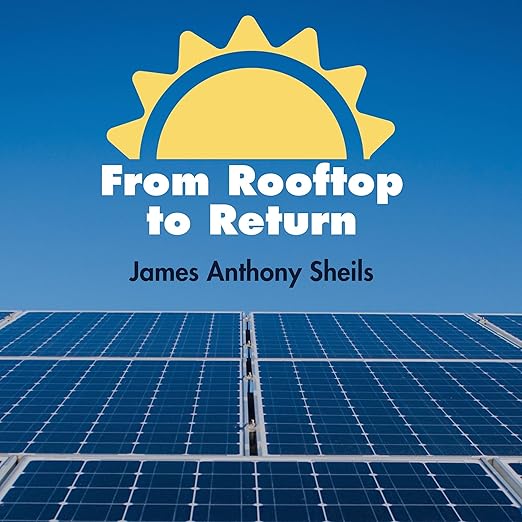
Solar energy guides are not what I typically reach for when I want a compelling listen. But From Rooftop to Return arrived at an interesting moment: I had just had my third conversation in a month with friends anxious about energy bills and wondering whether solar panels were worth the investment or just an expensive gesture. James Anthony Sheils writes this guide with a pragmatism that I found genuinely useful. There is no evangelising about saving the planet here, just clear-eyed financial thinking about a technology that has matured considerably over the past decade and is now within reach of ordinary UK homeowners rather than only early adopters with deep pockets.
At just over an hour, this is a compact listen, more extended briefing than comprehensive manual. But within that constraint, Sheils covers a surprising amount of ground, and the decision to position solar primarily as a financial investment rather than an environmental statement makes for a more honest and ultimately more persuasive argument. You will come away with a clearer sense of whether solar is right for your specific situation, and with better questions to ask the installers who will inevitably arrive at your door once you start enquiring.
About the Audiobook
Sheils organises the content around the practical journey a homeowner takes from first considering solar to eventually monitoring a functioning system. The opening section covers how residential solar systems actually work, explained without assuming prior technical knowledge and without the breathless simplification that sometimes makes technical audiobooks feel condescending. He moves through the essential calculations: how to estimate costs, project savings, and arrive at a realistic return-on-investment figure that accounts for your specific roof orientation, local weather patterns, and household energy consumption rather than relying on the optimistic national averages that installers tend to favour.
The guide then addresses the practical landscape of choosing equipment, navigating the installation process, understanding available government incentives and financing options in the UK, and preparing for the ongoing relationship with a solar system once it is generating. This last section is more useful than it might sound: many homeowners invest in panels and then fail to maintain or monitor them properly, leaving significant efficiency gains on the table.
What distinguishes this guide from competitors in the space is its refusal to oversell. Sheils acknowledges that solar is not a universal solution, that the calculations depend heavily on factors specific to each property, and that the financial case requires honest assessment rather than optimistic projection. For a short audiobook, it has admirable intellectual honesty. The book also covers the relationship between solar generation and home value, an increasingly relevant consideration in the UK market where energy performance ratings now play a measurable role in property transactions.
The Narration
Timothy Burke delivers the content in a clean, conversational register that keeps the technical material from feeling like a lecture. His pacing is brisk without being rushed, which is appropriate for a listen under ninety minutes. There is nothing showy about the performance, which is exactly right for a practical guide: the voice serves the information rather than drawing attention to itself. Burke handles the numerical content, the costs, percentages, and return-on-investment projections, with the kind of careful enunciation that makes figures easy to follow by ear rather than requiring a notepad. He also narrates Susan Clare Britton’s Awake in Love in this same batch, and it is interesting to note how effectively he shifts register between the practical and the reflective across two very different subjects.
What Readers Say
From Rooftop to Return is newly published and has not yet built a review record on Audible UK. Given the specificity of its subject and its short runtime, it is the kind of title that tends to attract a targeted, motivated audience rather than broad general listenership. Homeowners who have already begun the process of researching solar and who find this guide at exactly the right moment are likely to provide the most useful assessments. The lack of existing reviews is a function of its March 2026 recency rather than any reflection on its content.
Who Should Listen?
Homeowners in the UK who are actively considering solar installation and want a grounded, jargon-light orientation to the subject before engaging with installers or financial advisers will get genuine value from this listen. It is also worth an hour of anyone’s time who has been given conflicting or self-serving information by the solar industry and wants an independent framework for assessing those claims. At just over an hour, the time investment is minimal. It is not a substitute for professional advice tailored to your specific property, but as a primer that gives you the conceptual foundations and the right questions to ask, it is clear and practical.