Clara’s Verdict
Before I say anything else, a piece of practical information: the rating field for this audiobook on Audible returned a shopping cart error message rather than a score at the time of listing, and there are no listener reviews visible either. For a book released in March 2026, that is worth noting openly, and I would encourage you to sample before committing to the full purchase.
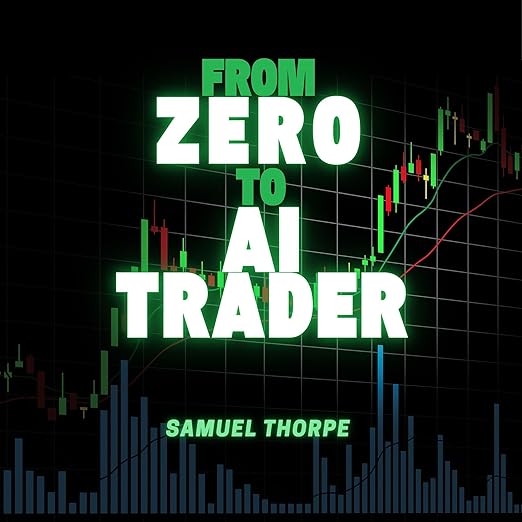
From Zero to AI Trader arrives at a moment when every corner of the financial self-help market has bolted the word “AI” onto its product. Samuel Thorpe’s premise, that you can master day trading in thirty minutes daily using artificial intelligence tools, is the kind of claim that deserves scrutiny rather than acceptance. The synopsis promises “bulletproof risk management,” “chart reading secrets,” and AI systems that “work 24/7.” That register, breathless, superlative, and free of nuance, is familiar from a certain kind of financial content creation rather than from serious trading education. Day trading as a practice carries a well-documented failure rate even among experienced participants; most retail traders who engage in it do not profit consistently, and any book that frames it as accessible to complete beginners “with no experience required” should carry that caveat prominently.
About the Audiobook
The book runs to 5 hours and 8 minutes, published by Three Rounds Design in March 2026 and narrated by Tom Brooks. Three Rounds Design is not a publisher with an established track record in financial education, and Samuel Thorpe does not appear in other recognisable contexts in this field. The absence of author credentials in the listing is a detail worth flagging: when books in this genre are written by practitioners with verifiable track records, those credentials are usually prominent, because they are the primary reason a potential reader would trust the advice being offered.
The topics the synopsis describes are legitimate subjects within trading education. Risk management, chart reading, and the use of algorithmic tools are all areas where solid guidance exists. The question is whether this audiobook provides that guidance with genuine rigour or remains at the level of aspirational framing. A five-hour runtime is short for a subject as technically involved as day trading, which either means the coverage is genuinely focused and efficient or that it remains at an introductory level that will leave serious learners wanting more. Without reviews, it is impossible to determine which.
It is also worth contextualising what “AI” means in this trading context, since the term is doing significant rhetorical work in the title. The AI tools available to retail traders in 2026 range from algorithmic scanners that flag chart patterns to natural language assistants that summarise market news. None of them reliably predict market direction; if they did, the advantage would be arbitraged away almost immediately by institutional participants with vastly greater computational resources. The most honest framing for AI in retail trading is not that it gives you an edge but that it automates certain repetitive analytical tasks, which is useful but not transformative in the way the subtitle implies.
The Narration
Tom Brooks is the credited narrator, though he does not appear in other notable audiobook productions at the time of writing. Without listener reviews or a sample to draw from, I cannot offer a meaningful assessment of his performance. The material, which the synopsis suggests is practical and instructional in nature, benefits from narration that is clear and methodical rather than dramatic. Whether Brooks provides that is something only a sample can confirm. For instructional finance audiobooks in particular, audio quality and pacing matter significantly: dense material delivered too quickly is difficult to process while listening.
What Readers Say
No listener reviews are currently available for this audiobook.
Who Should Listen?
If you are genuinely curious about how AI tools are being applied to retail trading and want a brief orientation to the landscape, this may serve as one data point among many. I would not suggest treating it as a reliable guide to actual trading decisions. Anyone considering active day trading should read widely in the academic and journalistic literature on retail trader outcomes, which is considerably more sobering than any self-help book in this genre. The body of evidence on retail day-trading performance is robust and not encouraging. Sample the audio before purchasing, verify the author’s credentials independently, and approach the “30 minutes daily” premise with healthy scepticism. If you want a grounded introduction to markets and investing behaviour, Morgan Housel’s The Psychology of Money covers related territory with much greater intellectual rigour and a large body of verified listener testimony.
The broader landscape of financial education audiobooks is worth knowing. John C. Bogle’s The Little Book of Common Sense Investing, though available primarily in print, represents the evidence-based end of the spectrum: low-cost index funds, long time horizons, minimal trading. This is the approach that decades of data consistently support for retail investors. The day-trading model that Thorpe’s book champions sits at the opposite end: high activity, high risk, reliant on skill and timing that the literature shows most retail participants do not reliably possess.