Clara’s Verdict
I want to be careful with this one, because Fruit Fly is doing something genuinely clever and genuinely uncomfortable, and the discomfort is not a side effect. Josh Silver has written a satire about literary extraction, about a writer who identifies a vulnerable human being as raw material, and the novel’s cruellest trick is that it makes you complicit in the same appetite. You keep listening because Leo’s life is terrible. That is exactly the mechanism the book is indicting.
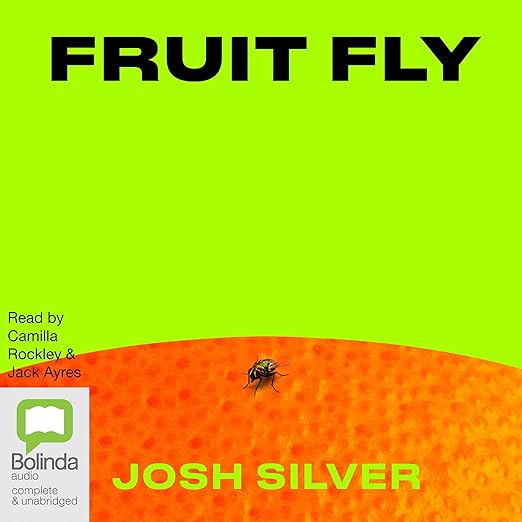
Thirteen hours and four minutes, narrated by Camilla Rockley, and it has surged up the Audible UK charts, which is remarkable for a novel this abrasive. Be warned properly before you start: multiple readers describe it as very dark, and they are not being delicate about it.
About the Audiobook
The publisher’s copy is the best summary anyone could write, because it is laid out as a recipe. “Anyone can write a bestseller. Here’s how.” Then three instructions: go gay, go sad, go dark. That formatting is the joke and the thesis in one move, presenting the manufacture of a prizewinning literary novel as a set of cynical ingredient choices.
Mallory shot to fame as a literary sensation seven years ago and has been stalled by writer’s block since, watching her career slide towards obscurity. Then she finds Leo, described without euphemism as “a young struggling addict sleeping under bridges and trading sex for survival”. He is vulnerable, he is enigmatic, and he is precisely what she has been looking for. The line that governs everything is stated flatly: “Authenticity sells, and there’s nothing more authentic than real life.” Mallory decides she is the right person to tell Leo’s story, and the question the book keeps sharpening is “just how far will she go to pen the perfect story?”
The material involves addiction, sexual exploitation, trauma and abuse, handled unflinchingly rather than gratuitously, and I would rather overstate that than have you meet it unprepared. Published in April 2026 by Bolinda, it stands alone.
The Narration
Camilla Rockley takes on a role with an unusually specific trap built into it. Mallory is monstrous, but a performance that plays her as monstrous from the first chapter destroys the book, because the satire depends on the listener finding her plausible, even sympathetic, while she does indefensible things. The reader has to be persuaded that Mallory believes she is helping. Rockley’s answer is to keep her warm and reasonable, which makes the calculations underneath far more chilling than any coldness would.
The second demand is tonal agility, and it is severe. One reviewer described laughing one minute and feeling guilty for it the next, and that whiplash has to be delivered by a single voice without signposting either mode. If the comic passages are played for laughs, the horror becomes tasteless. If the horror is played heavily, the comedy dies. Rockley holds the two closer together than I expected, treating both as simply what is happening.
Leo is the hardest thing in the book to perform, because he is written to resist being pinned down, and any interpretation that makes him legible undermines the whole point. Across thirteen hours Rockley keeps him slightly out of reach, which I suspect is deliberate and is certainly correct.
What Readers Say
Only 729 ratings sit behind the 4.5 here, which describes a smaller and more committed readership than the blockbuster titles around it in the charts, and the reviews are correspondingly more thoughtful. Readers here are not reporting entertainment. They are reporting an experience.
The best of them identified the novel’s real subject in a single question, asking whose story it is anyway and who gets to tell it, and called the book “Funny, unhinged, and quite scary too.” The same reviewer quoted her favourite line of the year:
Virginia Woolf would have loved Grindr.
That line does a great deal of work in six words, which is a fair indication of how the prose operates throughout. A four-star reader put the moral vertigo well, noting that “This book is so dark, you can’t decide if you should like any of the main characters”, since they shift so often that second-guessing becomes the default state, and warning that the subjects discussed are emotive for some more than others. Another described it as dark, uncomfortable and at times genuinely disturbing, while also being painfully funny, and added the sentence that best captures the reading experience: “I was laughing one minute and then the next feeling guilty for it.”
Who Should Listen?
Readers who like their literary fiction to have teeth should move this up the list. It sits in the company of Ottessa Moshfegh and Patricia Lockwood in its willingness to be repellent in service of an argument, and the publishing-industry satire will be especially pointed for anyone who works anywhere near books. The central question about ownership of a story is one of the more urgent literary arguments of the moment, and Silver has dramatised it rather than lectured about it.
Do not come to this for comfort, and do not come to it if addiction, sexual exploitation or self-destruction are subjects you need to keep at a distance. Three separate reviewers issued warnings unprompted, which is worth taking seriously. I would also say that thirteen hours in Mallory’s company is a genuine endurance test, and listening in shorter sessions rather than long immersive stretches makes the book considerably easier to live with. Nobody finishes this one feeling clean, and Silver has no interest in letting you.