Clara’s Verdict
Noam Chomsky reads his own work. This is not a neutral fact. It means that the intellectual rigour and the rhetorical method are inseparable in the audio: you are hearing the argument the way its author intends it, with the specific emphases, the careful qualifications, the occasional long pause before a conclusion that Chomsky has constructed to land with deliberate weight. For those who find Chomsky’s worldview uncongenial, the self-narration offers no refuge in a skilled neutral reader’s mediation. For those who find it compelling, it is the closest thing to sitting across from him and listening to him think.
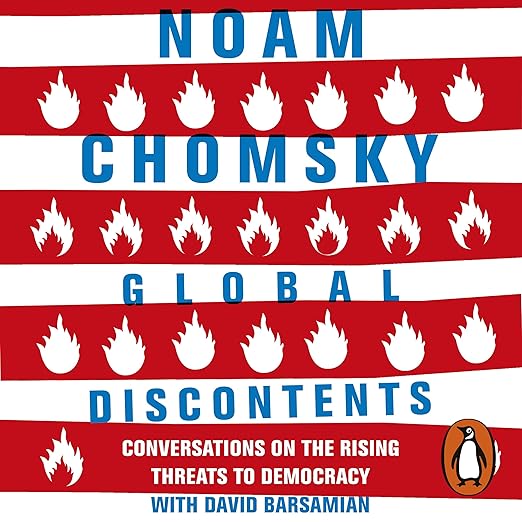
Global Discontents compiles ten conversations between Chomsky and his long-time interlocutor David Barsamian, conducted between 2013 and 2016. By the time of the audiobook’s UK release in 2018, the political landscape had shifted considerably, the post-2016 elections on both sides of the Atlantic having given Chomsky’s warnings about institutional fragility a new and specific urgency. The book holds 4.6 from 194 reviews, which for explicitly political content is a meaningful quality signal.
About the Audiobook
The conversation format serves Chomsky’s argument style well. Barsamian is not a pushover interviewer; he asks questions that allow the ideas to develop rather than those that merely prompt further agreement, and the exchange structure forces Chomsky to be responsive and concrete in ways that some of his more solitary writing can occasionally avoid. The topics range across climate change, the Syrian catastrophe, surveillance states, nuclear proliferation, and the failures of institutional democracy to address any of these adequately.
The personal reflections woven through the political analysis are among the most valuable material here. Chomsky traces his intellectual journey from childhood linguistic curiosity through his development as a political dissident, and the autobiographical dimension gives the abstract arguments a human context that straight-form political analysis often lacks. His sense of intergenerational responsibility, articulated through the book’s opening question about what kind of world we are leaving to our grandchildren, is not rhetorical but lived, and you can hear that in the narration.
The 2013-2016 timeframe does create a specific limitation. Some of the geopolitical analysis has been overtaken by events, and Chomsky’s framing of certain possibilities and risks has been both confirmed and complicated by subsequent developments. This is not a book that tells you what is happening now; it is a book that offers a framework for understanding how what is happening now came to be. Used in that way, it remains highly relevant. Used as a guide to current events, it requires supplementary reading.
A note on format: the conversation structure means the seven and a half hours are divided into ten distinct sessions, which makes this unusually well-suited to commute listening. Each conversation has its own topic focus and can be absorbed independently, though the accumulated picture is richer than any individual session. This is a rare quality in political non-fiction audio, where the argument often depends on linear accumulation.
The Narration
Chomsky’s voice has a particular quality, dry, precise, occasionally surprising in its warmth, that is itself part of the argument. He does not perform certainty; he presents evidence and draws conclusions with a slightly pedagogical cadence that makes the complex accessible without simplifying it. Barsamian’s interview voice provides useful tonal counterpoint. At seven and a half hours across ten conversations, the format naturally prevents any single section from becoming exhausting, and the dual-voice structure keeps the register varied throughout.
What Readers Say
The 194-strong review audience gave this 4.6 stars, a robust signal for a book this politically specific. "Changed how I look at the world," wrote one reader flatly. Another found it "fascinating," noting the consistent views expressed "without panic or fuss." Chomsky’s refusal to perform alarm even when the material is alarming is itself a rhetorical choice worth noting: it implies that clear-headed analysis is both possible and necessary, which is its own form of argument. A reader appreciated that "Chomsky makes his points in a language the average reader can easily understand," addressing the common concern that he is intellectually forbidding. In this conversation format, he is notably accessible.
The American Empire Project series label on the cover locates this book within a broader body of work that Chomsky and a range of associated authors have contributed to over many years: a sustained critical examination of US foreign policy, corporate power, and the gap between democratic rhetoric and institutional practice. Listeners who find Global Discontents compelling will find the series label a useful guide to related audio and print titles that develop the same intellectual framework in different geopolitical contexts.
Who Should Listen?
Essential for anyone already engaged with Chomsky’s work who wants to hear him reflecting on the specific period between 2013 and 2016 in his own voice and at his own pace. A good entry point for newcomers who want something less daunting than Manufacturing Consent as an introduction to his geopolitical analysis. Those who broadly disagree with his political framework should be aware that the book builds on its premises rather than arguing for them: this is a sustained development of a specific intellectual tradition, not an introduction to it as live debate.