Clara’s Verdict
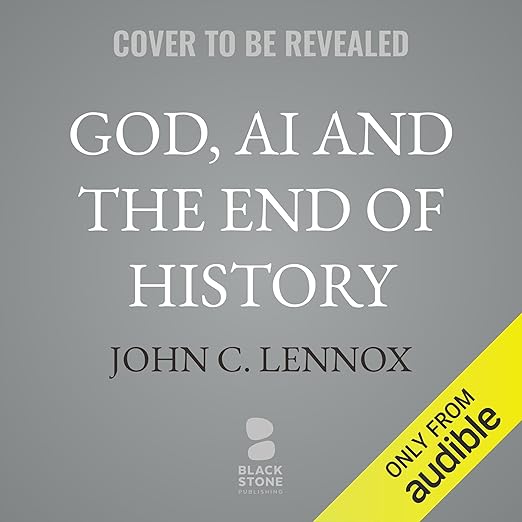
John Lennox occupies a rare position in contemporary intellectual life. He is a working Oxford mathematician who takes Christian theology seriously as a discipline rather than as a comfort, and he has spent decades engaging with the most demanding sceptics rather than retreating into communities of the already-converted. His debates with Christopher Hitchens and Richard Dawkins are substantial engagements with ideas, not performances. That background matters for understanding what kind of book God, AI and the End of History is. This is not soft apologetics. It is a genuinely ambitious intellectual argument, and at twenty-eight hours it demands to be taken seriously on its own terms.
I should be transparent about my own position: I am not a religious listener, and I came to this with scepticism about the core premise. What I found was that Lennox is making a claim that cannot be dismissed without engaging with it, and that the engagement is worthwhile regardless of whether you ultimately accept the theological framework. The questions he raises about AI, deception, and the erosion of shared epistemic ground are questions that secular analysts of technology are also asking, in different language.
About the Audiobook
Lennox begins with a thorough and fair-minded account of where AI development currently stands, drawing on mainstream technical literature, before pivoting to the theological framework that gives the book its organising argument. His concern is not that AI will become dangerous in a simple science fiction sense. It is that a sufficiently capable AI system could function as what the apostle John called a deceiver of nations, capable of manufacturing false realities at a scale no previous technology could match. He connects this to the figure of the Antichrist in Revelation, and he does so with the precision of someone accustomed to defending arguments in front of hostile questioners.
The book is aimed at a Christian readership, but Lennox is careful to explain the theological background for listeners who may be unfamiliar with eschatological literature. He does not assume you have read Revelation recently, and the exegetical sections are presented clearly enough that a non-specialist can follow the argument without losing the thread. The sections on AI ethics, the reliability of information in a world of generative content, and the erosion of trust between citizens and institutions are worth attending to regardless of where you stand on the theological dimension. At twenty-eight hours, there is real depth here, and the argument builds methodically rather than accumulating assertion.
The Narration
John Lescault narrates, and he is a strong choice for this kind of material. His voice has the gravitas that sustained theological and philosophical argument requires without tipping into the portentous. He does not deliver the text as if he were reading a sermon, which would quickly become exhausting across twenty-eight hours. The pacing through the more technical AI sections is particularly well-judged; Lescault slows down when the argument needs space to breathe and moves efficiently when the terrain is more familiar. A listening experience this long on this subject matter could easily become an ordeal, and the narration keeps it from doing so.
What Readers Say
Listeners have responded warmly, rating the book 4.6 from 139 reviews. Several describe it as thought-provoking and intelligent, with one specifically noting that Lennox has a distinctive gift for asking the listener questions in between explaining difficult concepts, creating something that feels more like dialogue than lecture. The phrase “Lennox at his best” appears in multiple reviews from his established readership, suggesting this is regarded as a significant rather than a minor work. The reviews skew heavily from within a faith tradition, which means independent critical responses to the AI argument from a purely secular perspective are harder to locate, but the engagement with the ideas appears genuine rather than performative.
It is also worth noting that Lennox is writing from within a specific theological tradition that places the Bible as authoritative scripture. Listeners who do not share that starting point will find the argument more interesting as a thought experiment than as a guide to action. But the thought experiment is a serious one. The question of whether advanced AI systems could function as agents of systematic deception on a civilisational scale is not a question that belongs exclusively to any religious tradition, and the fact that Lennox arrives at it through Revelation rather than through secular philosophy does not make the underlying concern less worth taking seriously.
Who Should Listen?
Essential for Christians who are thinking seriously about technology, ethics, and what their faith has to say about the AI moment. The questions it raises about deception, truth, and the manufacture of false reality are worth the time of any thoughtful listener regardless of religious background. This is not a quick or easy listen, and it is not light material. Approach it as you would a serious lecture series over several weeks rather than a single sitting. Listeners looking purely for a secular analysis of AI risk would do better to start elsewhere, but Lennox’s perspective adds something that entirely secular accounts cannot offer.