Clara’s Verdict
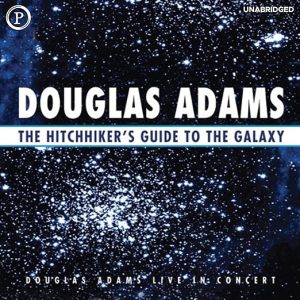
Before anything else: this is not the novel. What you are buying here is the original BBC Radio 4 full-cast serial, Fit the First to Fit the Sixth, remastered by Dirk Maggs, and it is the version that came before the book existed. I lead with that because a listener arriving in search of an unabridged reading of Douglas Adams’s prose will find something else entirely, and because the something else is arguably the better artefact.
A shade under four hours, a 4.8 average, and a listening experience that has almost nothing in common with a conventional audiobook. There is a cast rather than a narrator, a theme tune, sound effects, and the compressed episodic rhythm of a radio serial built to fit thirty-minute slots. If you have only ever met Hitchhiker’s on the page, this will feel simultaneously familiar and strange, and I would encourage the strangeness. The jokes were written for the ear, and here they are landing in the medium they were engineered for.
About the Audiobook
The serial follows Arthur Dent, Ford Prefect, Trillian, Zaphod Beeblebrox and Marvin the Paranoid Android through their first run of adventures. They witness the destruction of Earth to make way for a hyperspace bypass, stumble on the ancient planet of Magrathea, dine at the Restaurant at the End of the Universe and pursue an answer to the Ultimate Question of Life, the Universe and Everything. The cast is the original one: Peter Jones, Simon Jones, Geoffrey McGivern, Mark Wing-Davey, Susan Sheridan, Stephen Moore and a full supporting company.
The remastering is not incidental. Dirk Maggs, who directed the later Tertiary, Quandary and Quintessential Phases, has given the original recordings a fuller and more vibrant sound, added Philip Pope’s version of the familiar theme, and commissioned newly recorded announcements from John Marsh. The result sits comfortably in modern headphones without having been modernised out of its own period.
The arithmetic of the runtime is worth doing, because it tells you exactly what you are getting. Six half-hour episodes account for roughly three hours. The listing runs to three hours and fifty-six minutes, and the difference is a fifty-five minute bonus programme, Douglas Adams’s Guide to the Hitchhiker’s Guide to the Galaxy, which explores how the radio series came about and why it succeeded, with contributions from the original cast and production team. That bonus is close to a quarter of what you are buying, and it is a documentary rather than drama, so factor it in accordingly.
That makes this an unusually compact proposition. It is a single evening, or two commutes, and the episodic structure means it divides naturally into six clean stopping points. That density is a feature of the form rather than an abridgement: radio comedy of this vintage was written to waste nothing, and the pace is relentless in a way a novel adaptation cannot be.
The Narration
The narrator field simply reads Full Cast, and it is the most important thing on the listing. This is drama, not narration, and the distinction changes everything about how you should approach it. There is no single voice mediating the story, no reader interpreting dialogue, no descriptive prose being delivered. Characters speak, things happen audibly around them, and the Guide itself, the book inside the story, gets to speak.
That last device is the production’s masterstroke and the reason the material works better here than in any other medium. A book with a book inside it is an awkward structure on the page, requiring typographic tricks and a reader’s patience. In audio it can simply be another voice, and its interruptions land as a joke about tone rather than as a formatting problem. One reviewer here calls the Guide “the most wholly remarkable book in the universe”, which is the joke working exactly as designed.
My one caveat concerns the sound design. A remaster is a set of choices, and choices about a beloved recording are never neutral. My worry with any remaster of this vintage is that a fuller mix smooths away exactly the thinness that made the original sound like something transmitted from very far away, which for this material was part of the joke. On the evidence of the description Maggs has been careful, but it is the thing I would listen for first. What is not in dispute is the performance. These are the actors who created these parts, and the listing is right to make that its selling point.
What Readers Say
The affection in the review pool is considerable and the reviewers are mostly reaching for the same idea, which is that this is where everything began. One five-star reviewer opens by locating the whole saga precisely: “This is where it all started in a small house not that far from Taunton”, where Arthur Dent wakes to find yellow machines outside and his morning gets progressively worse. Another calls it a unique piece of radio with nothing to compare it to, noting that “These 6 half hour full cast radio episodes were the beginning of a mighty saga” that went on to cross space, time, radio, book, television and film.
The most useful review for a prospective buyer raises a specific reservation. That reviewer owned the cassette release twenty-five years earlier, recalls one or two different actors in the roles, and admits to wanting the exact experience they remembered. It is offered self-deprecatingly, as a childish quibble, then immediately outweighed: their children did not know those earlier actors and love this version regardless. The nine-year-old gets the whole thing and laughs uproariously at the improbability material, while the younger two struggle with the missiles turning into a bowl of petunias.
That review is doing something valuable. It flags the one thing an existing fan might actually notice, then honestly reports that it did not matter to the audience the recording was being played to. If you have a specific historical version in your memory, be aware that this one may differ in places.
Who Should Listen?
Anyone who wants the version that came first should start here, and that extends to anyone who has read the novels and never heard the serial, because it genuinely is a different work rather than an adaptation. Families are unusually well served: on one reviewer’s evidence it plays to children of around nine upwards, and its brevity makes it a viable car journey. Newcomers to Adams could do far worse than this as an entry point, since the compression means nothing outstays its welcome.
Anyone specifically wanting Adams’s prose should look for an unabridged reading instead, since a dramatisation and a novel are not interchangeable texts. Purists with a strong attachment to a particular earlier release should know that the remaster and the cast may not match their memory exactly. And if audio drama simply is not your format, with its music, effects and overlapping voices, then no amount of pedigree will change that, and this is drama through and through.
Listen to Hitchhiker’s Guide to the Galaxy free with an Audible trial