Clara’s Verdict
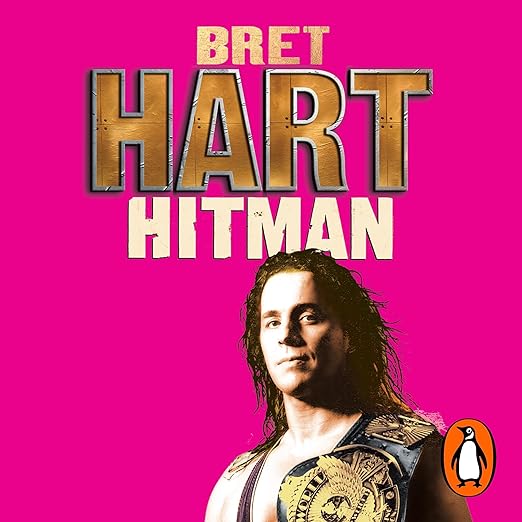
I grew up watching the WWF in the mid-nineties, as most British children of that era did, and Bret Hart was one of those figures who seemed to occupy a different moral category from the rest of the roster. He was the one you trusted to actually wrestle. I came to this memoir not as a superfan but as someone who wanted to understand what that world looked like from the inside – and Hitman delivered something I did not expect: a genuinely literary act of memory from a man who saw everything and is now willing to say it.
At nearly 25 hours of listening, this is a long commitment. But it earns every minute. Bret Hart narrates his own life with a bluntness that is disarming and occasionally uncomfortable. He names names. He revisits old grievances with the candour of someone who has nothing left to prove. The result is one of the most detailed insider accounts of professional wrestling ever put to audio – and one of the more compelling sports memoirs of recent years, regardless of genre.
About the Audiobook
Published by Ebury Digital and released in February 2026, Hitman spans Hart’s entire life – from childhood in Calgary as the son of wrestling promoter Stu Hart, through the Stampede Wrestling years, the ascent through WWF during the Hulkamania and New Generation eras, into the Monday Night Wars and the seismic Survivor Series 1997 screwjob, and on to his post-career life including his stroke in 2002 and its long aftermath. The coverage is extraordinarily thorough. This is not a memoir built around career highlights; it is a forensic account of how a family business, a physical art form, and a deeply strange professional world shaped one man across several decades.
Hart writes with particular attention to the relationships that defined his career – with Vince McMahon, with Shawn Michaels, with Owen Hart, with the road agents and writers and promoters who surrounded him. Some of these portrayals are generous. Others are not. The famous Montreal Screwjob receives extended and unsparing treatment. Readers hoping for a sanitised corporate biography will be disappointed; readers who want to understand how wrestling functioned as a labour industry, a family enterprise, and a creative form will find this essential.
The book also works as an inadvertent social history of North American masculinity across three decades of television sport. Hart’s account of the locker room culture of the eighties and nineties – the steroid use, the road life, the financial arrangements, the rivalries that were genuine and the ones that were performed – is as valuable as any sociological study of the same territory.
The Narration
Bret Hart narrates this himself, and that decision is load-bearing in a way that is immediately apparent. There is no actor’s interpretation between the listener and the events. When Hart describes the aftermath of Owen’s death in 1999, or the years of bitterness following Montreal, you hear the weight of it in his voice directly. He is not a trained narrator, and there are moments where the delivery is uneven – stretches of listing facts where a professional might have varied the rhythm. But the trade-off is authenticity of a kind that no professional casting could replicate. His dry Calgary cadence – unhurried, matter-of-fact, occasionally darkly funny – becomes the idiom of the book itself. He sounds like a man telling you the truth because he has decided, finally, to tell it.
What Readers Say
Listeners across decades of editions have consistently described this as the definitive wrestling biography. One UK reviewer who purchased the book twice – in 2007 and again in 2021 – called it “the best and most detailed autobiography ever,” citing the range from Stampede days through the Attitude era as its distinguishing quality. A more measured review appreciated the candour while noting that Hart “comes across very egotistical” – which reads less as criticism than as accurate character observation; this is, after all, a memoir by a man who christened himself the Best There Is, the Best There Was, and the Best There Ever Will Be. Several reviewers noted the book worked equally well for people with only passing knowledge of wrestling, citing the broader human drama as the hook. Publishers Weekly called it “amazingly detailed and meticulously crafted,” predicting it would stand the test of time as a definitive wrestling biography. The Audible release carries a 4.7 rating, though the count is still early – the book’s primary following comes from its long print history.
Who Should Listen?
This is essential listening for anyone who followed professional wrestling between 1984 and 2000. It is also genuinely worthwhile for readers interested in sports biography, family business, or the labour dynamics of entertainment industries. The content is adult throughout – the billing of “death, sex, betrayal and revenge” is not hyperbole. At 24 hours and 51 minutes, it rewards dedicated listening rather than dipping in and out; treat it as a novel-length commitment and it pays dividends accordingly.