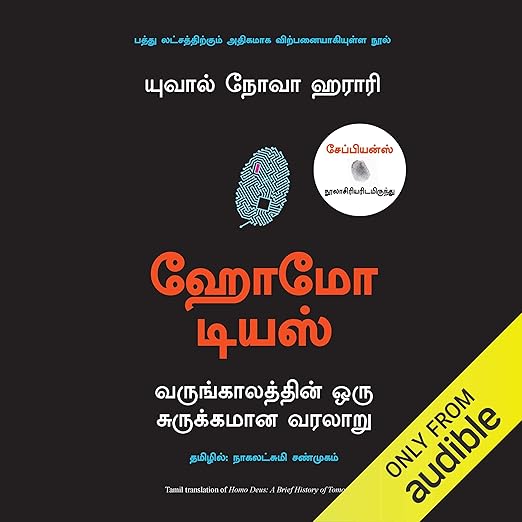
Homo Deus
Audiobook

Homo Deus, by Yuval Noah Harari

By Yuval Noah Harari

Read by Dharanidharan

★★★★★ 4.5/5 (249 reviews)
🎧 20 hours and 54 minutes 📘 Audible Studios 📅 2 mai 2023 🌐 Tamil
🎧 Listen on Audible UK 📖 Read on Kindle

Free 30-day trial · Cancel anytime

About this Audiobook

The world-renowned historian and intellectual Yuval Noah Harari envisions a near future in which we face a new set of challenges. Homo Deus explores the projects, dreams and nightmares that will shape the 21st century and beyond—from overcoming death to creating artificial life. It asks the fundamental questions: how can we protect this fragile world from our own destructive power? And what does our future hold?

Please note: This audiobook is in Tamil.

🎧 Listen free on Audible UK

Free 30-day trial · Cancel anytime

I want to be completely upfront before anything else: this listing on Audible UK is a Tamil-language edition of Yuval Noah Harari’s Homo Deus. The synopsis notes this in its final line, but the note is easy to miss if you are searching for the widely known English audiobook. The narrator is Dharanidharan, not the Derek Perkins version familiar to English-language listeners. If you are a Tamil speaker looking for access to one of the most discussed works of popular intellectual history of the past decade, this is a genuinely valuable resource. If you want the English edition, you will need to look elsewhere.

With that essential disclosure made, I want to give this the honest review it deserves for the audience it is actually serving. Tamil-language access to major works of global nonfiction is not as wide as it should be, and the appearance of Homo Deus in this form matters for Tamil-speaking readers in India, Sri Lanka, and the wider diaspora who prefer to engage with demanding intellectual material in their first language.

Clara’s Verdict

The ideas at the heart of Homo Deus are substantial enough that the quality of translation becomes genuinely load-bearing. Harari’s follow-up to Sapiens turns its gaze forward rather than back, asking what humanity might become once we have largely solved famine, plague, and war – the great afflictions that defined our story for millennia. His central thesis is both unsettling and rigorously argued: that having conquered nature, humanity now faces the possibility of being superseded by its own creations, and that the 21st century may witness the emergence of a new kind of human, shaped more by data and algorithm than by biology and tradition.

Harari covers the pursuit of immortality, the rise of artificial intelligence as an organising force in human life, and the philosophical possibility of dataism – the ideology that treats all reality as information flow and all consciousness as a processing function. These are not fringe ideas; they are the intellectual landscape of the present moment, and Harari maps them with the clarity and sweep that made Sapiens a global phenomenon. The question for this Tamil edition is whether that clarity has survived the translation process.

A review from India notes that the narration is ‘good but in some places getting difficulties to understand and feeling like continuity is missing between sentences’. This is a recognisable challenge in translating Harari specifically: his English prose builds arguments in a particular rhythm, each paragraph arriving as a clarification or escalation of the one before, and that architecture requires a translator who can match structure as well as meaning. The Tamil rendering appears to do the job, with some unevenness at the sentence-to-sentence level. For a 20-hour listen, those discontinuities are noticeable but not fatal to the overall argument.

About the Audiobook

Published by Audible Studios in May 2023, this edition runs to 20 hours and 54 minutes. The narrator is Dharanidharan. The language throughout is Tamil, and there are no English-language passages. The rating of 4.5 comes from 249 reviews, which is a meaningful and reliable sample reflecting Tamil-language readership primarily in India. The original book covers three main trajectories for 21st-century humanity: the biology-driven quest for immortality, the algorithmic systems that may come to know us better than we know ourselves, and the philosophical reconfiguration of meaning in a post-humanist world.

The Narration

Dharanidharan brings a measured, considered quality to 20-plus hours of demanding material. Tamil is a language with considerable expressive range, and the delivery here is suited to nonfiction: clear, not overly dramatic, and paced for comprehension rather than performance. The pacing issue noted by some reviewers – that sense of discontinuity between sentences in certain passages – may reflect the structural difference between Tamil and English syntax rather than any weakness in the narrator’s performance. For a Tamil speaker unfamiliar with the book’s English original, the narration will feel natural; for those who have engaged with the English version, the comparison may surface some awkwardness in the translated architecture.

What Dharanidharan does well is sustain authority across a very long runtime. Intellectual nonfiction narration requires the voice to carry conviction without tipping into lecturing, and the 249-review sample suggests he achieves this consistently enough to keep listeners engaged across the full 20 hours.

What Readers Say

Reviews come almost entirely from India. The most detailed comes from vengat manickam, who calls it ‘excellent’ while acknowledging the occasional continuity gaps. Suresh J describes it as ‘one of the best books in recent time and undoubtedly the most influential book in history’, which is generous phrasing but points to the genuine impact the material makes on first encounter. Mirath writes that everyone who reads this book ‘will definitely feel the amazing taste of knowledge’ – a description that captures the particular pleasure of Harari’s work, which consistently makes the reader feel that they are seeing familiar things from an angle that reveals entirely new dimensions. The consensus across reviews is strongly positive, with translation quality noted but not treated as prohibitive.

Who Should Listen?

Tamil-speaking listeners who want access to one of the defining works of early 21st-century intellectual nonfiction in their own language. Those who have already read or listened to Sapiens in Tamil and want to continue Harari’s conversation about the future will find this a natural progression. The 20-hour runtime is a commitment, and the density of the argument – particularly in the sections on consciousness, free will, and data-based governance – means this rewards active listening rather than passive background play. English-speaking listeners looking for the standard edition should seek the Derek Perkins narrated version separately.

Listen on Audible UK

Convinced?

🎧 Listen to Homo Deus free

Free 30-day trial · Cancel anytime

What listeners say

★★★★★

Excellent choice

Excellent book. Giving different view about future, not as a sci-fi movies. Giving examples from real life happenings. Making us to think and get answer from ourself. Good translation but in some places getting difficulties to understand and feeling like continuity is missing between sentences. Overall excellent book, nice translation….

— vengat manickam
★★★★★

Amazing work that gives new dimensions about the world and life

One of the best book in recent time and undoubtedly the most influential book in history for sure . Marvellous

— Suresh J
★★★★☆

About future

In previous book he talked about past, in this he discussed about the future like how human going to evolve, how the databases going to control us.

— Durai Balaji
★★★★★

The book every human must red.

must read book by every humn to know the human history and future. Everyone who read this book will definitely feel thevamazing taste of knowledge.

— Mirath
★★★★★

Good

Liked it

— Senthilkumar

Listen to the audiobook: Homo Deus


Free 30-day trial · Cancel anytime

Clara Whitmore

By Clara Whitmore

Founder & Literary Critic