Clara’s Verdict
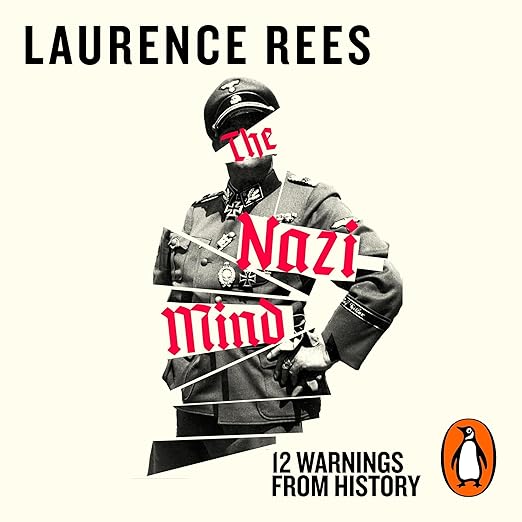
Laurence Rees has spent the better part of his career asking a question that resists easy answers: how did ordinary people do what the Nazis did? The Nazi Mind, his most direct attempt yet to address it, is genuinely exceptional – rigorously researched, clearly written, and possessed of an urgency that makes it feel less like a work of history than a work of diagnosis. The Sunday Times Bestseller designation is accurate, but it doesn’t capture the book’s peculiar quality of being both academically serious and immediately accessible.
At over fourteen hours, it is a substantial audiobook. It earns every minute.
About the Audiobook
Rees’s central argument is structured around twelve “warnings” – observable features of fascist movements, from the construction of in-groups and out-groups to the escalation of rhetoric into mass violence – which he traces through the rise and fall of the Nazi regime. These warnings are not abstract formulations; they are rooted in specific testimony, specific decisions, and specific individuals whose psychology Rees examines in careful and unflinching detail.
The book draws on previously unpublished testimony from former Nazis and people who grew up within the Nazi system, combined with cutting-edge psychological research on obedience, authority, and group behaviour. The work of Stanley Milgram, Philip Zimbardo, and more recent researchers on moral disengagement is woven into the historical narrative in ways that illuminate both the history and the psychology simultaneously. Rees is particularly interested in the gap between how perpetrators understood their own actions and what those actions actually were – the cognitive mechanisms that allowed commandants of death camps to regard themselves as dutiful professionals rather than murderers.
The final section, which considers the contemporary relevance of the twelve warnings, is handled with admirable restraint. Rees is not interested in easy political point-scoring; he is interested in pattern recognition as a practical survival skill. Sir Ian Kershaw, the pre-eminent British Hitler biographer, called it “disturbing, timely, relevant and important,” and the assessment is exact.
One of the book’s particular strengths is its refusal to treat the perpetrators as simply monstrous and therefore exceptional. Rees’s psychological research consistently points in the opposite direction: the capacity for the behaviours he documents is not confined to a particular nationality, religion, or political tradition. The conditions that enabled them are what matters, and those conditions can be recreated. That conclusion is what makes the book feel urgent rather than merely historical.
The Narration
John Sackville’s narration is sober and authoritative – precisely what this material demands. He navigates the book’s oscillation between historical narrative and psychological analysis without losing the thread, and his handling of the testimony sections – often harrowing in their detail – is measured without being cold. Sackville trusts the material to carry its own weight, which it does, and never imposes an editorial response onto content that is already doing its own work. At fourteen hours, the pacing is consistently well-judged; this is a long audiobook that never feels padded.
What Readers Say
Listeners have responded with unusual intensity. One UK reviewer wrote that “every page contains nuggets of information about the rise of fascism” and found the historical parallels to contemporary right-wing politics unmistakeable and sobering – “if you fail to learn from history, you are doomed to repeat it.” Another was so absorbed within the first hundred pages that he felt compelled to leave a review immediately, calling it “insightful, thought-provoking, and relevant to what is happening in today’s world.” A third traced the book’s structural arc from post-World War One Germany through the formation and consolidation of Nazi power with evident admiration for Rees’s narrative clarity. The audiobook holds a rating of 4.6 out of 5 from 543 listeners – a substantial and serious readership.
Who Should Listen?
Readers of history, psychology, and current affairs will all find substantial value here. This is not a book for the faint-hearted – the material is relentlessly dark and the historical content includes detailed accounts of atrocity – but it is scrupulously fair and never sensationalist. If you’ve read Rees’s earlier works – The Holocaust: A New History or Hitler and Stalin – this is the logical next step: less narrative overview, more analytical depth, and more explicitly concerned with what the history means now.
An essential audiobook for anyone trying to understand how democracies slide into authoritarianism, and why that process is so difficult to interrupt once it has begun.
It is worth pairing with Rees’s earlier Hitler and Stalin: The Tyrants and the Second World War for a fuller picture, but The Nazi Mind stands entirely on its own merits and is arguably the more immediately useful of the two for a contemporary audience. Alastair Campbell described it simply as a book he would “recommend to everyone,” which is as succinct a summary of its value as any.
Find The Nazi Mind on Audible UK here: Listen on Audible UK