Clara’s Verdict
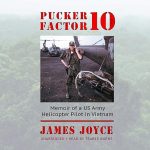
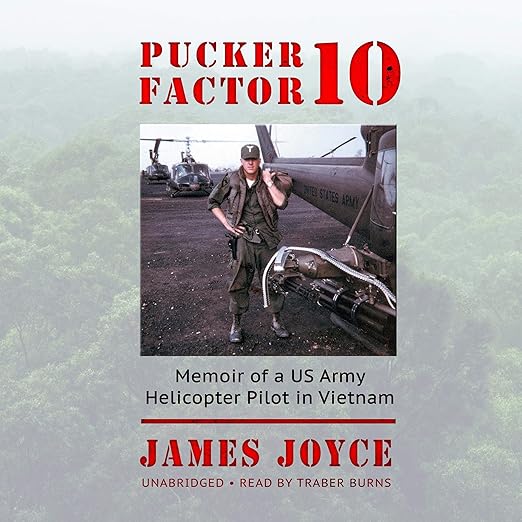
The Vietnam War memoir is a well-established genre, and the best of them – Michael Herr’s Dispatches, Karl Marlantes’s Matterhorn, Robert Mason’s Chickenhawk – share a quality of direct, visceral testimony that makes the academic history of the conflict feel abstract by comparison. James Joyce’s Pucker Factor 10 belongs in this company. It is the account of a helicopter pilot – the quintessential Vietnam role – and it carries the particular moral tension of a man who flew both Huey Slicks and Gunships: first inserting troops into landing zones under fire, then, on the Gunships, delivering the fire himself. That divided perspective – defender and attacker, the same man in the same aircraft – is one of the things that makes this memoir unusual and worth reading beyond its genre.
About the Audiobook
Joyce was drawn into the US Army through the ROTC programme – sitting in a classroom in Ohio, raising his hand, a decision that seemed straightforward at the time and was anything but. His account of training and deployment is thorough and specific, covering the particular psychological and physical demands of helicopter operations in a way that rewards readers with no prior military knowledge. The title refers to flight-crew slang for peak “pucker factor” – the extreme physiological response to imminent danger – and Joyce uses it with the wry self-awareness of someone who experienced it repeatedly and is still here to describe it.
The memoir’s approach is neither sensationalist nor falsely heroic. Joyce documents his own fear, the camaraderie and dark humour of his unit, the day-to-day routines between missions, and the specific weight of knowing that any sortie might be the last. He is equally direct about the men he served with, many of whom did not come home, and about the institutional chaos and moral complexity of the war itself. One of the book’s notable elements – noted by reviewers – is that a crash Joyce describes in graphic detail was captured on film in a French documentary called The Anderson Platoon, available on YouTube; the ability to watch the scene you’ve just heard described is an unusual and sobering addition to the reading experience.
The Narration
Traber Burns narrates, and he handles the material with the respect it deserves – steady, grounded, and appropriately restrained. Military memoir benefits from a narrator who doesn’t dramatise unnecessarily, who trusts the events to carry the emotional weight without being pushed. Burns understands this. He delivers the jargon of helicopter operations fluently and handles the more difficult passages – accounts of death, of moral compromise, of the psychological aftermath of sustained combat – without overstatement. At just over eight hours, this is a focused and well-paced listen.
What Readers Say
A substantial 756 ratings average 4.3 stars – a significant audience for a specialist memoir. UK reviewers placed it naturally in the tradition of Chickenhawk, calling it “a good book in the same vein” while noting its own specific authenticity and the additional dimension offered by Joyce’s dual role on Slicks and Gunships. One reviewer drew particular attention to the YouTube documentary connection, noting it as a remarkable example of history made suddenly immediate. Others praised Joyce’s “honest, readable style” as particularly effective at communicating the Vietnam experience to readers who had never served and might not have expected to find themselves so thoroughly absorbed.
Who Should Listen?
Essential for readers interested in Vietnam War history from a ground-level, operational perspective, and particularly for those drawn to aviation memoir. Listeners who enjoyed Chickenhawk or We Were Soldiers Once… and Young will find Joyce’s account a valuable companion volume. It also works for readers with no prior interest in military history who want to understand what service in Vietnam actually felt and looked like from the inside – the moral complexity, the institutional chaos, and the extraordinary ordinary courage demanded of the people who flew. Listen on Audible UK – this is history from the seat of a Huey, and it stays with you.
A note for listeners interested in going deeper into the material: the documentary mentioned in multiple reviews – The Anderson Platoon (1967), directed by Pierre Schoendoerffer – is available on YouTube and documents the American unit whose experiences overlap with Joyce’s memoir in a specific and remarkable way. The ability to watch archival footage of events described in the audio creates an unusual layering of testimony that gives the history a particular vividness. It is worth watching before or after listening, and either order works.
The period detail is another of the memoir’s quiet strengths. Joyce captures the specific cultural atmosphere of a US military unit in Vietnam in the late 1960s – the music, the slang, the dark humour, the particular quality of boredom punctuated by extreme danger – in a way that brings the historical moment vividly to life without romanticism or retrospective moralising. He is writing from within the experience as it was, not from the vantage of subsequent decades of interpretation.