Clara’s Verdict
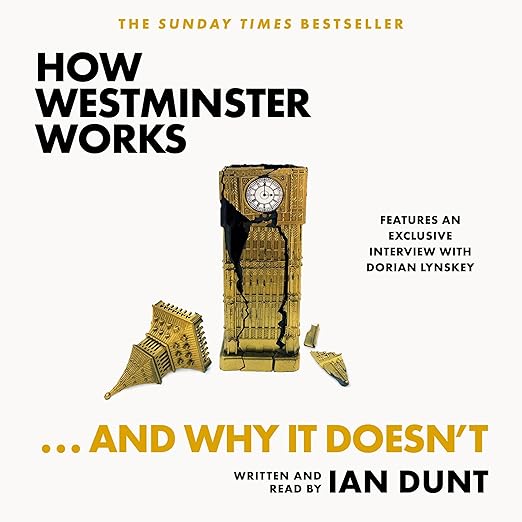
Political journalist Ian Dunt has spent his career explaining British politics to people who are confused, frustrated, or simply trying to understand why nothing seems to work the way it should. How Westminster Works – and Why It Doesn’t is his most ambitious attempt at that explanation: a comprehensive, accessible guide to the machinery of British government, from candidate selection through to the operations of Whitehall, the Commons, the Lords, and the architecture of the civil service. It is, without exaggeration, one of the most useful books about British political life published in the past decade.
Dunt reads it himself, which is exactly right. His voice is the voice of someone who cares deeply about this material and is, beneath the careful restraint of the prose, quite substantially furious about most of it. This is an important book written with controlled passion, and the audio version benefits enormously from the author’s own investment in the argument.
About the Audiobook
The book is structured as a guided tour of the British political system, proceeding from first principles – how constituencies work, how candidates are selected and parties shaped, what MPs actually do during a working week – through the mechanics of Parliament, the relationship between the executive and the legislature, the role of the civil service, the operations of special advisers and how they came to dominate political life, the function and more than nominal utility of the House of Lords, and the broader architecture of British public institutions that most people barely know exists.
Along the way, Dunt explains why some prime ministers succeed in getting things done while others fail entirely; why the special adviser class has expanded so dramatically and what that expansion has cost in accountability; why secrecy and archaic custom make the system so difficult for outsiders to understand, let alone challenge; and why the Treasury’s structural dominance over every other department produces the policy distortions it reliably produces. The analysis is careful, evidenced, and – for a book written by someone with clear political sympathies – notably fair about the structural problems that transcend party affiliation. An audio-exclusive interview with Dorian Lynskey is included as a bonus for Audible listeners.
The Narration
Dunt narrates his own book, and the effect is bracing. He is a clear, assured speaker with the kind of controlled passion that political journalism at its best tends to produce – a journalist who has covered this territory for long enough to understand it deeply and still find it outrageous. At ten hours and thirty-five minutes, this is a substantial listen, but the material sustains it without flagging. Weidenfeld & Nicolson’s production is clean and professional throughout, with excellent audio quality. An audiobook-exclusive interview with journalist Dorian Lynskey, exploring the book’s themes in conversation, adds additional value for Audible subscribers.
What Readers Say
The audiobook carries a 4.6-star average. Reviewers consistently describe it as “essential reading,” “exceptionally good and important,” and “outstanding and well researched.” One listener compared it to Bagehot’s nineteenth-century constitutional analysis – high praise in the political science tradition. The book is consistently praised for its accessibility – one reviewer noted that anyone could read it and everyone should – its rigour, and its ability to make material that is usually considered boring feel urgent and consequential. One reviewer who did not share Dunt’s political sympathies nonetheless acknowledged the quality of the research and the fairness of the analysis, which is as good an endorsement of intellectual honesty as any author can hope for.
Who Should Listen?
The book’s timing is notable: written and published as the UK approached a general election, and continuing to resonate strongly in the years since. The structural problems Dunt describes – the concentration of executive power, the weakness of parliamentary scrutiny, the dominance of the Treasury, the architecture of unaccountable influence – are not specific to any one government. They are features of the system itself, and understanding them as such is considerably more useful than attributing dysfunction to individual bad actors, which is the standard media shorthand and consistently fails to explain the pattern.
Anyone who wants to understand why British politics feels so persistently dysfunctional – and who wants that understanding grounded in structural analysis rather than partisan complaint. The book is essential background for voters, for anyone engaged in political life at any level, and for journalists or students of public policy who want a comprehensive overview of how the system actually operates in practice rather than in constitutional theory. It is written in plain English and requires no prior expertise in political science. If you have ever found yourself confused, infuriated, or simply baffled by the behaviour of British governments, this is the book that explains the mechanisms – and why changing them is so difficult.
Listen to How Westminster Works and Why It Doesn’t on Audible UK – the essential guide to British political machinery and why it matters.