Clara’s Verdict
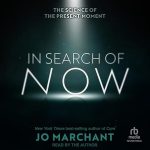
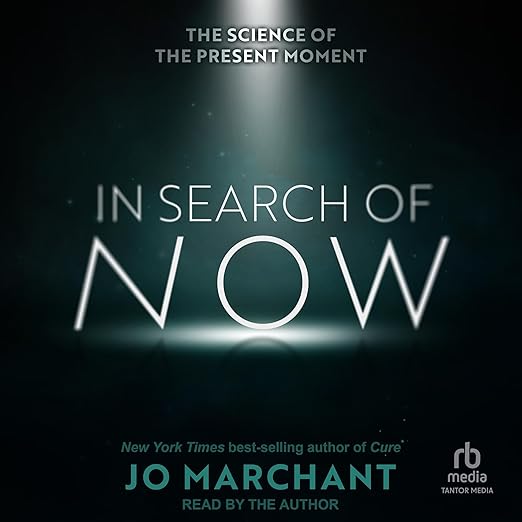
Time is the one thing we all live inside but almost none of us can explain. Jo Marchant, one of the most sure-footed science writers working today, has spent years pulling at this thread, and In Search of Now is the result: a book about why the present moment feels so vivid and inescapable, even though physics insists it doesn’t really exist. At nearly eleven hours, this is a substantial listen, but Marchant’s prose – delivered in her own voice – is never dense or forbidding. This is narrative science at its best: genuinely curious, intellectually honest, and written by someone who has thought hard about the limits of what we currently know. It asks the kind of question that, once planted, refuses to stop growing. A standout audiobook for 2026, and one I expect to be recommending for years.
About the Audiobook
The central puzzle Marchant is wrestling with is deceptively simple: what is Now? We experience the present moment as real, immediate, almost physically solid – it bathes us, as she puts it, like air or gravity. And yet the best models in physics describe a universe in which time is just another dimension, no moment more real than any other, and the flowing present we all inhabit is an illusion stitched together by the mind. So where does that leave us? Are our brains constructing a fiction? And if so, what does that fiction tell us about consciousness, memory, and the self?
Marchant moves through physics, neuroscience, cosmology, and psychiatry without losing the thread. She reports from the frontier of research into time perception – why time seems to speed up as we age, why a traumatic event can stretch seconds into hours, why certain neurological conditions disrupt the sense of sequential experience altogether, and what this tells us about the machinery behind the feeling of being present. The book is part personal journey and part philosophical meditation, but it is grounded throughout in real science rather than hand-waving. Marchant is scrupulous about distinguishing what is well established from what is speculative, which gives the more provocative claims their proper weight.
Running at almost eleven hours, In Search of Now has the scope of a proper intellectual expedition. Marchant covers enormous ground – from the physics of block time to the neuroscience of temporal perception to the psychiatric experience of time distortion – and does so with the narrative confidence of someone who has spent years making hard science accessible without dumbing it down. Listeners will emerge from it having genuinely reconsidered something fundamental about their relationship to experience itself.
The Narration
Marchant reads her own work, which is always a risk – scientists are not always performers – but here it pays off considerably. She has a thoughtful, measured delivery that suits material requiring slow unpacking. There is no performative drama, just a writer thinking out loud, which feels appropriate for a book fundamentally about introspection and uncertainty. Complex concepts benefit from being paced by the person who wrote them; Marchant knows where to pause and where to let an idea breathe before introducing the next complication. Her voice carries the quality of someone genuinely excited by the questions she is asking, and that quiet enthusiasm is infectious across eleven hours. Listeners who prefer highly theatrical narration may find her understated, but for this particular subject matter, restraint is exactly the right choice.
What Readers Say
In Search of Now was released in March 2026 and carries a perfect rating of 5.0 from its first Audible UK listeners. Given the subject matter and Marchant’s reputation – her previous book Cure was widely praised for the same combination of rigorous research and accessible prose – strong responses from readers who engage seriously with popular science are entirely expected. Listeners drawn to Carlo Rovelli, whose The Order of Time covers related ground from a more purely philosophical angle, or to Oliver Sacks, whose work on neurological experience informs several of Marchant’s chapters, will find this a natural companion and extension of that tradition.
Who Should Listen?
This audiobook is made for anyone who has ever wondered why five minutes in a boring meeting lasts longer than five minutes of joy, or who has read a popular physics book and found themselves genuinely unsettled by the idea that the present moment is not fundamental to reality. It suits curious, patient listeners who don’t need a strong narrative drive to stay engaged – the pleasure here is in the quality of thought, not in forward momentum. Neuroscience readers, philosophy enthusiasts, and anyone working through the bigger questions about consciousness and perception will find In Search of Now enormously rewarding. It is also an excellent gateway into the broader literature on the science of time for those approaching these ideas for the first time.