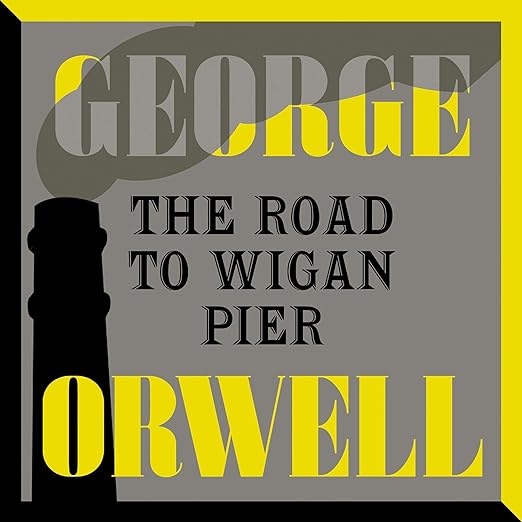
Clara’s Verdict
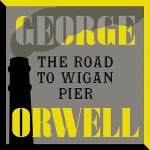
There are books you read because they’re important and books you read because they’re urgent. Orwell’s The Road to Wigan Pier has always been both, but in the current political moment – with the north-south divide as entrenched as ever, working-class communities still bearing the weight of deindustrialisation, and the left still struggling with the same problems of class, language, and authenticity that Orwell diagnosed – it feels uncomfortably, almost embarrassingly current. Written after Orwell spent months living in the slum conditions of northern England’s mining communities, it is part documentary journalism of devastating precision and part furious self-critical polemic. Both halves are indispensable.
If you’ve never read it, this is the moment. If you read it at school and remember it as dry, read it again. It isn’t.
About the Audiobook
The book divides into two distinct parts that feel almost like different genres in uneasy and productive dialogue with each other. The first half is reportage: Orwell goes to Wigan, Sheffield, and Barnsley at the height of the Great Depression and records what he finds with the unflinching honesty of a journalist who has chosen to live what he’s reporting rather than observe it from a safe distance. The conditions he describes – overcrowded lodging houses with shared beds, the backbreaking and health-destroying labour of the mines, the humiliation of the means test, the slow attrition of poverty on human dignity and aspiration – are rendered with a specificity that makes them impossible to dismiss. These are people with names, smells, faces, and daily lives recorded with the care of a novelist and the rigour of an investigative journalist.
The second half shifts register entirely. Orwell turns his critical intelligence on the middle-class socialist movement he nominally belongs to, indicting its condescension, its cultural revulsion from the working class it claims to champion, and what he sees as its fundamental failure to build genuine solidarity across the class divide. He is provocative, sometimes wrong, regularly brilliant, and written with an honesty about his own class prejudices – his own residual horror at the smell of coal dust – that remains startling. Orwell was not an easy man to be, and this book shows exactly why that mattered.
It’s worth noting that Orwell was commissioned to write the first half only, by Victor Gollancz for the Left Book Club. The political second half was his own addition, and Gollancz published it with a disclaimer distancing the Club from Orwell’s more provocative arguments. That tension – between the reporter’s authority and the polemicist’s provocation – runs through the entire book and is part of what makes it so alive. Orwell was genuinely trying to think, not just to persuade, and the thinking is visible in all its contradictions. Few political books offer the same quality of intellectual honesty about the thinker’s own limitations. Jonathan Keeble’s seven-hour reading is paced to give the text its full weight – he doesn’t allow the second half’s polemical passages to collapse into lecture.
The Narration
Jonathan Keeble is an inspired choice for Orwell. He has the right quality of controlled moral outrage – never performative, never detached – and his vocal grounding feels appropriately physical for a text so concerned with bodies, labour, and material reality. The shift in register between the journalistic first half and the polemical second is handled with intelligence: Keeble understands these are different rhetorical modes and adjusts accordingly.
What Readers Say
Rated 4.4 out of 5 from Audible reviews. “Orwell’s look at class distinction and his view of the beginnings of the Socialist movement is a real eye-opener,” wrote one listener from Wigan who felt the particular resonance of the local connection. Another offered the balanced assessment: “enlightening but hard work,” noting that the second half can be repetitive and some references are dated by eight decades. Both responses are honest. This is a great book, not an easy one, and the difficulty is part of what it offers.
Who Should Listen?
Anyone interested in British social history, the politics of class, or the history of the left in Britain. Essential alongside Down and Out in Paris and London and Orwell’s essays for anyone studying his work. Also, I would argue, required reading for anyone genuinely puzzled by British political geography – Orwell diagnosed the fault lines in 1937 and they have not healed.
A word about the audio format specifically: Orwell’s prose rewards the ear in a way that some political non-fiction doesn’t. He’s a writer who thinks in images and particular details rather than in abstract categories, and those concrete images – the smell of a lodging house, the precise geometry of a miner’s posture underground – land differently when read aloud than when processed silently on the page. Keeble’s reading gives them the physical weight they deserve. This is one of the titles I’d particularly recommend in audio over print.
Listen on Audible UK. Also available on Kobo.