Clara’s Verdict
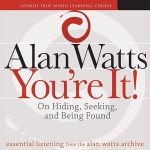
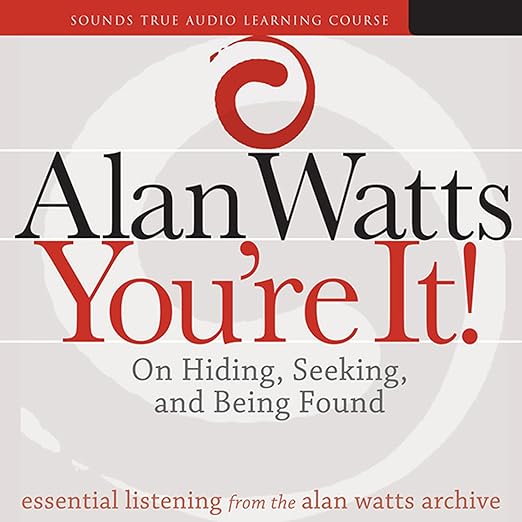
There is no one quite like Alan Watts. He was born in Chislehurst, Kent, in 1915, trained in Anglican theology, became an Episcopal priest, left the clergy, and spent the rest of his life in California writing and lecturing about Eastern philosophy for Western audiences who had no idea they needed it until they heard him. He wrote more than twenty-five books and recorded hundreds of lectures. He died in 1973, but his recorded lectures have remained in continuous circulation for good reason: he possessed the rare ability to take ideas of genuine philosophical complexity – the nature of consciousness, the self, the relationship between the individual and the cosmos – and make them feel immediately recognisable rather than abstractly remote. Not trivial. Recognisable: as though you’ve always half-known this, and just needed someone to stand in front of you and point at it. You’re It! collects fifteen of his classic talks, selected and restored by his son Mark Watts, covering Taoism, Buddhism, the art of getting out of your own way, and what Watts describes as “the divine drama of existence.” At twelve hours, this is a substantial and deeply nourishing collection. It is also among the best introductions to Watts’s thought currently available in audio form – which is exactly the format these talks were always meant for.
About the Audiobook
The central insight Watts returns to, in different forms across these fifteen talks, is the title’s premise: the universe is playing hide and seek – with itself, through us – and everything we seek through spiritual practice, self-improvement, or meditation is always already present in the seeker. This sounds abstract and mystical and can easily be dismissed as such; Watts’s genius is that he makes you feel it rather than simply understand it. He approaches the same territory from multiple angles: through the Taoist concept of wu wei, the art of non-forcing; through Buddhism’s dissolution of the ego; through Hinduism’s notion of Atman as Brahman; through the Western philosophical tradition he was trained in at King’s College London; through Japanese poetry; through the simple, devastating observation that the effort to become enlightened is performed by the exact same mind that is supposedly the obstacle. The talks are live performances before real audiences – you can feel the room in them, the laughter, the surprised recognition – and Watts performs them with a comedian’s timing and a philosopher’s precision. He is genuinely funny, and that matters more than it might seem. Ideas that might feel oppressive or demanding in the hands of a solemn teacher become liberating when delivered with Watts’s irreverence.
Why Audio Is the Right Format for Watts
It’s worth being explicit about something: Watts’s talks were never intended to be read on a page. They were performances – a live philosopher working through ideas in front of an audience, responding to the room, adjusting his pacing to the material. Reading a transcript of Watts is like reading a screenplay: you get the words, but you miss everything that makes them work. The restored recordings collected here give you the actual experience – including the laughter, the silences, the slight shift in register when he’s about to say something important. For anyone who has only encountered Watts in print, this collection will be a revelation.
The Narration
Alan Watts himself, recorded before live audiences, with audio carefully restored by Mark Watts. The quality is good throughout – clear enough to follow without strain, with enough ambient warmth to remind you these are real performances in real rooms. Watts’s voice is distinctive: measured, wry, inflected with the accent of an Englishman who spent decades in California and retained the best qualities of both cultural inheritances. There is no narration in the conventional sense. There is only Watts, thinking aloud in front of a room of people, and you would be hard pressed to find a more compelling teacher to spend twelve hours with.
What Readers Say
With twelve ratings averaging 4.7 stars, this collection is highly regarded by everyone who has found it. Ingvar Nordin writes that “nobody lectures quite like him, in a lingo so natural and full of humour, delivering surprising but – when you reflect on them – quite obvious facts about life and the living.” Francesca calls the talks “profound and life-changing teachings from one of the great minds of the 20th century,” recommending them to anyone “too caught up in their own thoughts.” Ray, who pairs Watts with J. Krishnamurti and Ram Dass for maximum effect, notes that it was Watts who finally made “the experiencer is the experience” feel like something more than words: “listen to Alan and see for yourself,” he writes, and I can’t improve on that.
Who Should Listen?
Anyone curious about Eastern philosophy who finds formal religious texts impenetrable. Anyone trapped in the hall of mirrors of self-improvement, trying to fix themselves with the very mind that’s supposedly the problem. Anyone who has sat through enough meditation sessions to suspect there might be something fundamentally wrong with the framing. Anyone who simply wants to feel less alone in a universe that sometimes seems indifferent. Listen to You’re It! by Alan Watts on Audible UK – and perhaps stop looking quite so hard for whatever you think you’re missing.