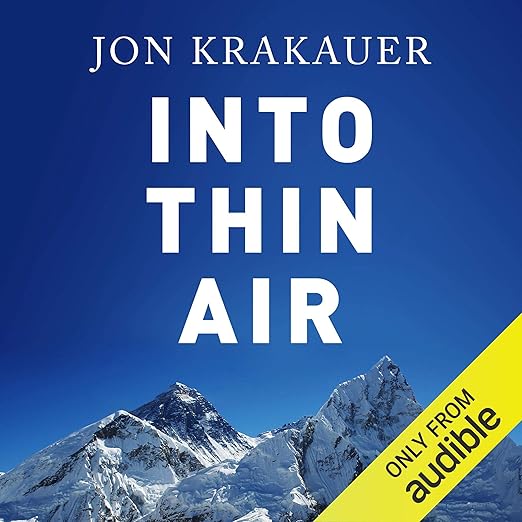
Clara’s Verdict
There are books about extreme places and books that actually put you in them. Jon Krakauer’s Into Thin Air is emphatically the second kind. I first encountered it in my early twenties and spent an entire night with it, not in the mountaineering sense but in the sense that I genuinely could not put it down. The Audible Studios production, narrated by Philip Franklin and rated 4.6 from 23 Audible UK listeners, holds up as one of the more accomplished narrative non-fiction audiobooks on the platform, and the production date of 2016 has not diminished it. Some accounts of disaster acquire a kind of settled authority over time, and this is one of them.
Krakauer was sent to Everest by Outside magazine in the spring of 1996 to write about the commercialisation of summit expeditions. He came back having survived the worst single-season death toll in the mountain’s history, and with the obligation to write about people he had known and liked who had died on his watch. The result is not a comfortable book, and it was not meant to be.
About the Audiobook
The 1996 expedition led by Rob Hall was not a private adventure; it was a commercial operation, and the distinction matters enormously to the argument Krakauer makes. By 1996 the mountain had become, in significant part, a consumer experience for wealthy clients whose fitness for the summit was sometimes genuinely in question, and whose presence on the mountain on summit day created conditions that put more experienced climbers at risk. Krakauer makes that argument carefully, knowing that he himself was one of those clients, that his presence contributed to the congestion on the fixed ropes, and that his own perceptions during the storm were compromised by the altitude at which he was operating.
The nine-hour runtime moves through three distinct registers. The first is chronicle: Krakauer establishes the history of Everest attempts from the earliest expeditions through to the particular circumstances of the 1996 commercial season, and introduces the personnel of the Hall, Fischer, and Taiwanese expeditions with enough detail that their fates, when they come, carry real weight. The second register is testimony: the ascent and the storm, narrated with a journalist’s precision and a survivor’s guilt. The third is reckoning: Krakauer’s sustained attempt to understand what happened and why, including the disputed decisions made in the final hours above the South Col. He does not reach conclusions that fully satisfy him, and he does not pretend to.
The book has not been without controversy. Anatoli Boukreev, a guide on the Scott Fischer expedition whose actions Krakauer criticised, published a detailed rebuttal disputing several characterisations. That dispute remains alive in the literature of Everest, and Krakauer acknowledged in later printings some of the limitations of his account. That acknowledgement is itself part of what makes the book valuable: it is an account by a man who was there, who knows what altitude does to perception and judgment, and who is honest about both what he saw and what he might have missed.
The Narration
Philip Franklin reads with a steady, grave authority that suits the material without sentimentalising it. He handles the technical mountaineering vocabulary, fixed ropes, jumar ascenders, the Death Zone, the Hillary Step, with the assurance of someone who has done his research thoroughly, and the prose’s most emotionally weighted passages are given appropriate space without becoming theatrical. At nine hours his energy is consistent throughout, and the tone he establishes at the opening, serious without being portentous, holds to the final chapter. This is a careful, professional performance that serves a serious book.
What Readers Say
UK reviewers describe an experience of complete immersion. One book club reader called it well written, saying it conveyed excitement and thrill, grim reality and physical hardship, and ultimately the horror and trauma of the disastrous outcome, and said she couldn’t put it down. Another described the experience of being transported into the expedition’s footsteps in a way that cinema could not quite achieve, through the filth and squalor at Base Camp to the structured danger of the Khumbu Icefall and the terrifying silence above the South Col. A third praised its informative density, noting that it teaches you not only what happened in May 1996 but the entire history of Everest and the century of attempts that contextualise the 1996 tragedy.
Who Should Listen?
Listeners with an interest in extreme environments, decision-making under pressure, or the ethics of guided commercial adventure in dangerous places. True-crime and true-tragedy readers who want the same quality of reported detail in a very different setting from their usual genre. Also for anyone who watched the 2015 Everest film and felt the story deserved more complexity: it does, and Krakauer provides it. Not for those who want reassurance. The mountain does not offer any, and neither does this book.