Clara’s Verdict
I came to this one with my editorial guard up, because a full cast on a Lisa Jewell thriller could very easily be a marketing decision dressed as an artistic one. It is not. This audiobook is built the way the novel is built, which is to say out of separate voices circling a single house in Hampstead, and the production has understood that the structure is the point.
Jewell is doing something quietly clever with time. The book opens on a night twenty-five years ago that Jane Trevally survived by running, then drops her outside the same front door in the present holding a small white dog. The gap between those two moments is where the whole novel lives. It is not a fast thriller and it does not pretend to be. It is a slow tightening, and at ten hours and forty seven minutes it has the room to do that properly.
The recording is currently sitting well up the Audible UK bestseller charts, and with more than four thousand ratings averaging 4.5 it has an unusually solid listener record for a thriller this new. My one real reservation is about how much attention the opening hours demand, and I will come to it, but it is the reservation of someone who finished the book across two long evenings.
About the Audiobook
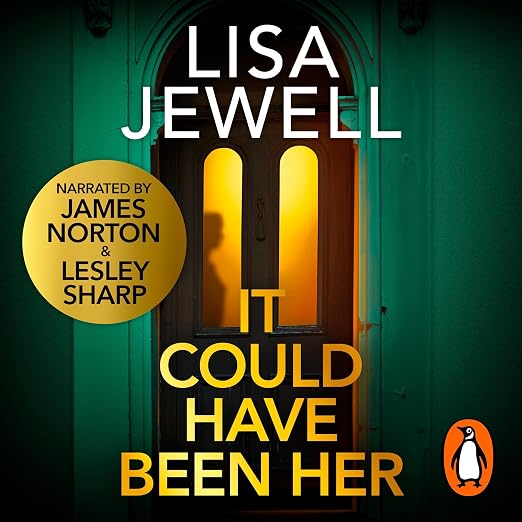
Jane is newly divorced and, in the publisher’s phrase, feeling a little lost when she agrees to go home with a man she does not know. The house sits in what the copy calls “the darkest corner of Hampstead Heath”. She is offered a drink, she goes inside, and then there is a scream and the sound of something falling upstairs. She runs. That is the first few minutes, and it is a brutally efficient opening because it withholds absolutely everything except the physical sensation of getting out.
Twenty five years later Jane is living in the country when a small white dog turns up near her home. Its owner has just been reported missing. Returning the animal takes her back to that same address, where she catches a glimpse of a haunted looking woman at a window. From there the novel becomes the story of an amateur investigator working on a house rather than on a person, which is an unusual and rather brilliant shape for a thriller to take.
Penguin have cast this as an ensemble piece. Lesley Sharp leads, and the company includes James Norton, Joanna David, Emilia Fox, Freddie Fox, Tim McInnerny, Ella Rae Smith, Harriet Fisher, Elsa Lepecki Bean and Roy McMillan. That is a serious commitment of resource, and it signals what the novel does with point of view. This is not one woman’s account. It is several accounts laid against one another, and the fact that they do not quite agree is where the dread comes from.
The Narration
Lesley Sharp is the anchor and the reason the whole thing holds. She has a plain, unshowy, faintly amused delivery that suits Jane precisely, because Jane is not a professional investigator and should not sound like one. Sharp lets her be curious, a little bored, and rather braver than she has any business being. When the fear arrives it arrives without a gear change, which is far harder to do than it sounds.
The multi-voice construction earns itself in the sections away from Jane. A single narrator managing ten characters across a twenty-five-year gap has to signal every switch, and signalling is exhausting across a book this long. Here the switches simply happen. You know you have moved because the voice in your ear belongs to a different human being. One reviewer noted that the novel uses multiple points of view without ever becoming confusing, and I would argue the casting is a large part of why.
My one caution concerns concentration. An ensemble production rewards attention and punishes half listening, particularly in the early hours before the relationships between the strands are clear. If you tend to listen while doing something demanding, give this one the first two hours undivided and it will repay you handsomely.
What Readers Say
With a 4.5 average across more than four thousand ratings, this has the kind of consensus Jewell readers will recognise from None of This Is True and Don’t Let Him In. The written responses are notably consistent about one thing: the pace is slower than her recent books, and almost nobody minds.
“Although it isn’t quite as fast-paced as some of her previous novels, the slower burn only made me more invested.”
That comes from the reviewer writing as Fabulous Book Fiend, who puts the point of total capture at around the sixty per cent mark. A second reviewer praises Jewell’s clarity, calling her style “clear and straightforward”, and identifies the book’s real trick: a story about a woman who narrowly escaped a serial killer, grim in its particulars but carried by how appealing its central character is. A third is blunter and just as useful. “The sleuthing duo was a treat to read about.” That reviewer also singles out the pacing as perfect.
One honest note. Most of the written feedback here reads as a response to the novel rather than to this recording, with reviewers talking about pages and about reaching the final page. That is common with a simultaneous release, and it means specific praise for Sharp and the cast is thinner on the ground than the overall score might lead you to expect.
Who Should Listen?
Come to this if a full cast sounds like a feature rather than a distraction, and if you are content to let a thriller take its time. It suits long drives and long walks far better than ten minute fragments. Existing Jewell readers can proceed without hesitation, since the writing is recognisably hers and the construction is more ambitious than most thrillers attempt.
I would steer two groups elsewhere. If you want a thriller that grips inside the first hour and never loosens, the deliberate build may frustrate you before it converts you. And if you are sensitive to sustained material about violence against women, this is a book about a predator and a house that concealed one, handled seriously but not gently. For everyone else, ten hours in the company of Lesley Sharp and a very good ensemble is a genuinely fine way to spend a week of commutes.