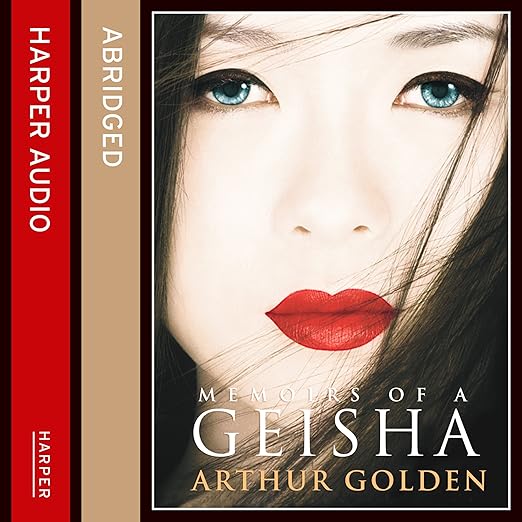
Clara’s Verdict
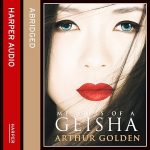
I came to this particular edition of Memoirs of a Geisha already knowing Arthur Golden’s novel well. I read the print version years ago and remembered it as a richly layered portrait of pre-war and wartime Japan, filtered through the invented autobiography of Sayuri, a geisha who rises from poverty in a fishing village to become one of Kyoto’s most celebrated figures. What I was not fully prepared for was discovering that this Audible edition runs to just two hours and fifty-nine minutes. That is an abridgement, and a fairly severe one. Golden’s novel is a substantial work, and three hours cannot do justice to a story spanning roughly a quarter of a century, from 1929 through to Japan’s post-war transformation. I want to be upfront about that before anything else: if you are coming to this title expecting the full novel in audio form, you will be disappointed.
With that caveat firmly in place, is what remains worthwhile? For a listener who simply wants a taste of the story, or who wants a companion piece to Rob Marshall’s 2005 film adaptation, the answer is a qualified yes. But for anyone who wants the full experience of Golden’s prose and the complete arc of Sayuri’s world, this edition is a compromise, and a significant one.
About the Audiobook
Memoirs of a Geisha was first published in 1997 and became an international phenomenon, though not without controversy. Golden, an American man writing in the first person as a Japanese woman, was later accused by Mineko Iwasaki, the real geisha whose interviews informed the book, of misrepresenting her and breaching her confidence. That background is worth knowing, because the novel’s authority and authenticity have always been contested. What Golden produced is, nonetheless, a compelling narrative: the story of Chiyo, a poor fisherman’s daughter sold into a geisha house in Gion, Kyoto, who reinvents herself as Sayuri and navigates a world of extraordinary beauty, rigid hierarchy, and often brutal exploitation. The novel spans from 1929, through the devastation of the Second World War, and into Japan’s economic transformation in the post-war years. This Audible edition is published by HarperCollins and was released in February 2006, placing it in the era of the film adaptation. The abridged runtime of under three hours is the principal structural fact any prospective listener needs to absorb before making a decision.
The synopsis describes it accurately as an extraordinarily vivid and beautifully written first novel exploring the hidden world of the geisha. In the complete text, that vividness is earned across hundreds of pages of carefully observed detail: the rituals of the okiya, the hierarchies between geisha and maiko, the intricate social economy of the hanamachi, and the slow accumulation of years that shapes Sayuri’s character. In the abridged version, those details are necessarily compressed or excised, and what remains is the emotional spine of the story rather than its full body.
The Narration
Noriko Aida is a Japanese narrator, which is a meaningful casting choice for a story told in the first person by a Japanese woman. For a novel that attracted criticism over its cultural authenticity, having a Japanese voice in the narrator’s role adds a layer of credibility to the performance that a non-Japanese narrator simply could not provide. Her voice brings a particular quality of restraint and precision to Sayuri’s account: she does not overplay the emotional peaks, which suits a character who has been trained from childhood to conceal her inner life behind a composed exterior. The few listener reviews available note that the narration handles the texture of Sayuri’s experience without melodrama, and I think that reading is accurate. Aida’s performance is thoughtful and controlled. The limitation is not her delivery but the material she has been given to work with: an abridged text that necessarily rushes through some of the novel’s most affecting passages. Her reading of the wartime sections, in particular, is quietly done, and in a full-length version that restraint would feel like a deliberate and powerful stylistic choice. Here, it can feel simply as though there is not enough room for the story to breathe.
What Readers Say
With only eighteen ratings on Audible UK and an average of 4.5 stars, the sample is small but consistent. Listeners praise the novel’s insight into Japanese culture and its engagement with how the Second World War shaped ordinary lives. One reviewer, writing around the eightieth anniversary of Victory over Japan in August 2025, found it a timely listen for exactly that reason, noting how interesting it was to see the war’s effects on ordinary Japanese people from an interior perspective. A more critical response acknowledges the novel’s uncomfortable treatment of the romantic relationship between Sayuri and the Chairman, noting that by contemporary standards it involves what would now be recognised as the grooming of a child, and that Golden does not entirely conceal this. Several reviewers mention being surprised to discover that the novel is fictional rather than autobiographical, which speaks both to the persuasiveness of Golden’s first-person technique and to the importance of contextualising the book before diving in. The consensus is that the world-building is vivid and the geisha culture rendered with considerable detail, even if the portrait is ultimately a Western literary construction.
Who Should Listen?
This edition suits listeners who want a brief and accessible introduction to the story, perhaps before or after watching the 2005 film, or those with limited time who want the emotional shape of Sayuri’s journey without committing to a full-length recording. It is not the right choice for anyone who wants the complete experience of Golden’s prose, the full weight of the wartime section, or the extensive detail of geisha training and cultural ritual that makes the novel distinctive as a work of literary historical fiction. For a richer audio experience, tracking down a complete unabridged recording is well worth the effort. Listeners who are sensitive to depictions of exploitation, including the selling of a young girl’s virginity, or to the ongoing debates about cultural appropriation surrounding this title, should know that both elements remain present even in the condensed version.