Clara’s Verdict
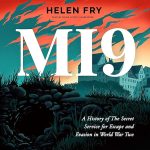
I finished MI9 on a quiet Sunday afternoon, and I sat with it for a while afterwards. Helen Fry has written the kind of history that makes you feel the specific weight of courage: not the cinematic version, but the cold, domestic, terrifying kind. This is the story of an organisation most people have never heard of, staffed by individuals whose names appear in no popular histories, who saved thousands of Allied lives through networks of extraordinary bravery running through Nazi-occupied Europe. Fry’s achievement is to make that invisible infrastructure visible and human without sacrificing historical rigour.
There is a particular type of WWII history that focuses on the mechanisms behind heroism rather than heroism itself – on the clandestine logistics, the forged papers, the safe houses, the escape lines that zigzagged through occupied territory towards the neutral borders of Spain and Switzerland. MI9 is one of the best examples of that mode I have encountered, and it is remarkable how little of this history has permeated popular consciousness given the scale of what the organisation accomplished and the depth of courage it required of those who supported it.
About the Audiobook
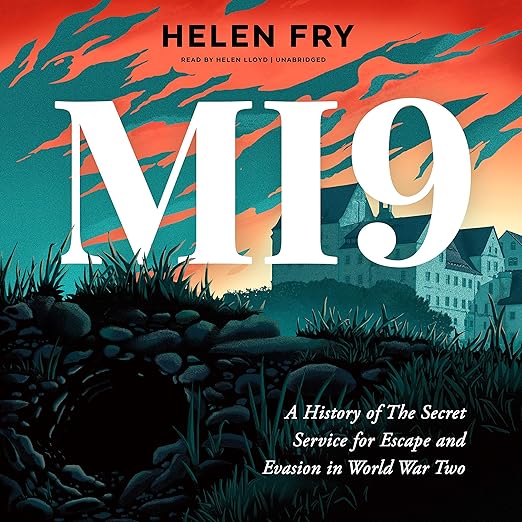
Published by Blackstone Publishing on 3 November 2020, MI9 runs for 13 hours and 3 minutes. Drawing on declassified files and eye-witness testimonies gathered from across Europe and the United States, Fry provides a significant reassessment of MI9’s wartime role and restores to prominence several figures who have been largely absent from popular history. Central among them are Airey Neave, Jimmy Langley, Sam Derry, and Mary Lindell – one of only a handful of women parachuted into enemy territory specifically for MI9 operations. The Comet escape line, running from occupied Belgium through France and over the Pyrenees into neutral Spain, features prominently. So does the constant, ever-present threat of betrayal that shadowed every node of the network – a threat that was not theoretical but routine, and that cost many helpers their lives or their freedom.
This is properly archival history: not reconstructed narrative, not dramatised conjecture. The evidence base is serious and the analysis is careful. Fry is not writing for dramatic effect; she is writing to restore a historical record that has been unjustifiably neglected. That rigour gives the book its authority. The book holds 4.4 out of 5 from 218 listeners on Audible UK, which reflects its sustained reputation among readers of serious WWII non-fiction over several years of availability. A rating at that level from that many listeners is a meaningful endorsement for a work of specialised history.
The Narration
Helen Lloyd brings a composed, authoritative tone to the material that suits it perfectly. This is dense history with a large cast of names, codewords, and operational details spread across multiple countries and years of conflict, and Lloyd reads it with clarity and measured pace throughout thirteen hours. She allows the weight of individual stories to register without overdramatising – a restraint that proves the right choice when the material is as genuinely harrowing as some of the evasion accounts are. The execution of a betrayed operative, the exposure of a safe house, the separation of families who had hidden Allied servicemen for months: these moments do not need theatrical emphasis to land.
She navigates French, Belgian, and German names with ease, which matters considerably in a book where geography and personnel are so closely intertwined. The voice is steady without being cold – there is evident respect for the people whose lives are being recounted, and that register of respectful authority serves the history well across the full runtime.
What Readers Say
shamus carter (5 stars): “What the people in occupied countries did to help people get back to England is beyond me, putting their lives and their families at great risk. I felt humble thinking about them.”
Amazon Customer (4 stars): “So well researched. It brings the personnel to life and creates sympathy for them. Why has this been kept from our eyes for so long!”
Amazon Customer (5 stars): “A comprehensive account of MI9’s involvement in helping the various escape lines to function, while always under the risk of betrayal and capture. Provided key insights into Andree de Jongh, Airey Neave and others. A very useful account of a little studied organisation.”
Hilbil (5 stars): “Amazing secrets of the Secret Service. Full of admiration for those who lived through it.”
Who Should Listen?
Strongly recommended for listeners with an interest in WWII history, intelligence operations, or the experiences of ordinary civilians under occupation. This is not a battlefield memoir – it is organisational and espionage history, focused on the logistics of escape and the human cost of clandestine work. Readers seeking dramatic combat narrative may find the pace more measured than expected. Those who appreciate rigorous archival research rendered into readable, humanising history will find this one of the stronger accounts of the secret war. It serves as a valuable corrective to the tendency of popular WWII narratives to focus almost exclusively on the experience of soldiers and commanders, at the expense of the civilian networks that made escape possible at all. A book that deserves to be better known.