Clara’s Verdict
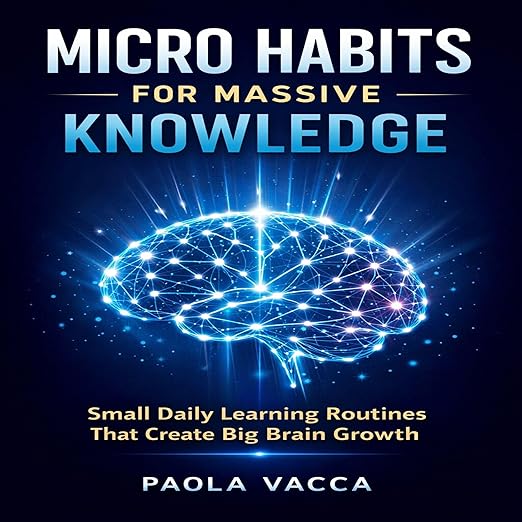
The micro habits genre has proliferated to the point where it takes a particular clarity of execution to justify another entry. Paola Vacca’s Micro Habits for Massive Knowledge makes a reasonable case for itself: the specific focus on learning retention rather than general productivity gives it a useful niche, and the science underlying the approach – neuroplasticity, spaced repetition, retrieval practice – is solid. At just over an hour, it is one of the most concise audiobooks I’ve encountered in this space, which is either a virtue or a limitation depending on what you need from it.
For listeners already familiar with the scientific literature on habit formation and memory, this will cover known ground. For those coming to these ideas fresh, it is an efficient and accessible introduction. Scott LeCote’s narration is clear and professional, and the brevity prevents the fatigue that can accompany longer self-help productions.
About the Audiobook
Vacca’s central thesis is that the problem most adult learners face is not intelligence or motivation but system design. We consume information constantly – articles, podcasts, books – but retain very little of it because we never give that information the conditions it needs to consolidate into memory. The solution, she argues, is not longer study sessions or more discipline but smarter micro-habits: small, daily practices that work with the brain’s natural learning architecture rather than against it.
The book draws on well-established cognitive science: the spacing effect (information retained better when reviewed at intervals), retrieval practice (testing yourself rather than re-reading), and interleaving (mixing different topics in a single session). These are not new ideas, but Vacca’s contribution is translating them into specific, low-friction daily habits that fit around a working adult’s schedule.
The 10-minutes-a-day framework is the book’s practical core, and Vacca is specific about how those minutes should be spent. The personalised micro-learning plan element – designing habits that fit individual schedules and learning goals – is the most practically useful section, and it is given appropriate emphasis.
At one hour and eighteen minutes, this is closer to a detailed essay than a conventional audiobook, but the discipline of brevity has concentrated rather than diminished the content.
The Narration
Scott LeCote narrates with a clean, unhurried style that suits the material. He avoids both the breathless urgency that afflicts some self-help narration and the soporific monotone of academic reading – landing instead in a neutral, engaged register that communicates the author’s enthusiasm without performing it. For a book making practical arguments, clear delivery is the essential requirement, and LeCote meets it consistently.
What Readers Say
This title is very recently published (March 2026) and has not yet accumulated listener reviews. The absence of ratings makes recommendation more tentative, but the quality of the underlying content – grounded in established cognitive science rather than self-help invention – provides a reasonable basis for confidence.
The book sits alongside a well-established body of work in this area: James Clear’s Atomic Habits, Peter Brown’s Make It Stick, and Barbara Oakley’s work on learning are obvious predecessors, and listeners who have benefited from those works will find Vacca’s contribution compatible and complementary.
Who Should Listen?
Working adults who feel they have lost the habit of learning since leaving formal education, and who want a science-based approach to rebuilding it. Particularly useful for professionals in fast-moving fields who need to update their skills continuously but struggle to find time. Students looking for more effective study habits will also find practical value here.
The short runtime makes this an easy first listen – you could complete it on a single commute. The value lies not in the listening but in the implementation, and Vacca is clear that the habits require actual practice rather than passive absorption. A good use of just over an hour.
Available on Audible UK. Also check Scribd and Storytel.