Clara’s Verdict
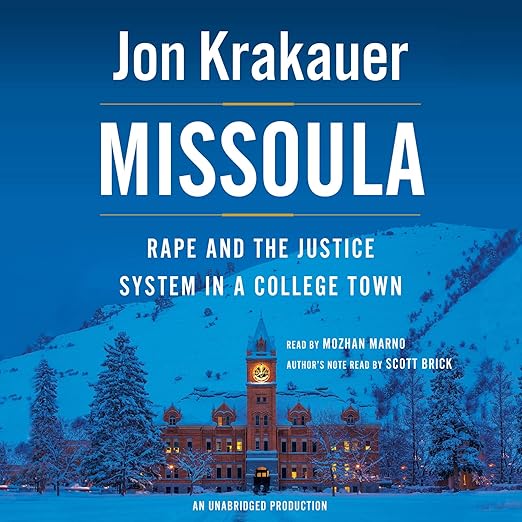
There are books that inform and books that disturb, and then there are rare books that do both simultaneously, leaving you sitting with a discomfort you can’t easily shake. Jon Krakauer’s Missoula is one of those. Having spent twelve years commissioning non-fiction, I’ve read a great deal of investigative journalism in manuscript. What Krakauer achieves here is something that eludes most reporters: he makes you feel the full weight of institutional failure without ever losing sight of the individual women whose lives were upended by it.
This is difficult listening. It should be. The subject – a series of sexual assaults at the University of Montana, and the catastrophic failures of the university and local justice system in responding to them – demands rigour, and Krakauer delivers it with his characteristic precision. It is a book that will likely change how you think about consent, evidence, and institutional loyalty.
About the Audiobook
Krakauer spent years documenting the experiences of multiple women in Missoula, Montana, following the Department of Justice investigation that examined 350 reported sexual assaults between 2008 and 2012. His account is meticulously sourced: court transcripts, police reports, university proceedings, and extensive interviews form the backbone of a narrative that refuses to sensationalise.
The structural achievement of the book is considerable. Krakauer manages to tell several interlocking stories simultaneously – cases that reached trial, cases that were dropped, cases handled by the university’s internal processes – while building a coherent argument about why acquaintance rape remains the most underreported serious crime in America. He documents the way victims were treated not just by alleged perpetrators but by police, prosecutors, defence attorneys, and an entire community that had invested its identity in the success of the Grizzlies football team. The DOJ’s finding that 110,000 women aged eighteen to twenty-four are raped annually provides the statistical frame; the individual stories provide the human reality.
A UK reviewer noted that the power dynamics described – entitlement conferred by athletic celebrity, institutional reluctance to act – are not uniquely American phenomena. The parallels with cases closer to home are impossible to ignore.
The Narration
Mozhan Marnò narrates across nearly twelve hours, and her performance is exceptional. She brings a restraint to the material that is absolutely right – there is no editorialising, no performative emotion, simply a clear and measured delivery that allows the facts themselves to carry the weight. When the accounts become graphic, she does not flinch or embellish; she reads with the composure of someone who trusts the material. This is precisely what this kind of journalism demands from a narrator, and Marnò delivers it.
What Readers Say
The book holds a rating of 4.3 across five reviews. One UK listener called it “should be compulsory reading,” describing the way it illuminates rape myths that have been unconsciously absorbed. Several noted that Krakauer’s “signature style” – cool, methodical, deeply reported – makes the book compulsively readable even when the content is almost unbearable. One reviewer described it as “powerful” and “one of the best I have ever read,” adding that it was impossible to put down. The phrase “not for the faint hearted” appears more than once, used not as a deterrent but as honest guidance.
Who Should Listen?
Anyone who wants to understand the structural conditions that enable campus sexual violence – and why reporting it is so difficult – should listen to this. It is essential for students, educators, policymakers, and anyone who has ever wondered why survivors don’t simply go to the police. It is not comfortable. It is necessary. Krakauer is at his best when the stakes are highest, and they don’t come much higher than this.
Available now on Audible UK: Listen to Missoula by Jon Krakauer on Audible UK.