Clara’s Verdict
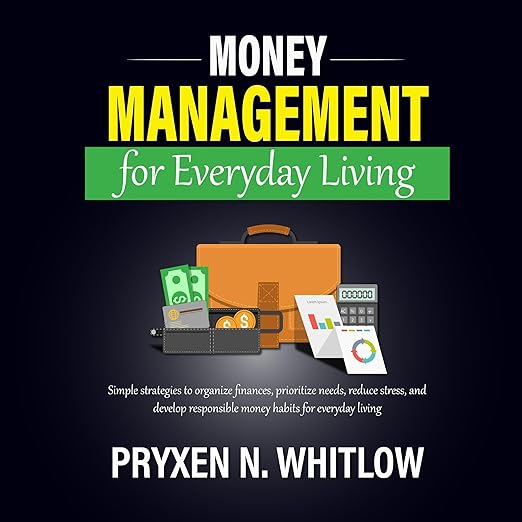
Personal finance audiobooks occupy an interesting and somewhat uneven position in any catalogue: the best of them, Ramsey, Clason, Morgan Housel, earn their recommendations because they articulate something genuinely true about behaviour and money that most people have not articulated clearly for themselves. The rest earn a place because someone needed to write one and someone else bought it. Money Management for Everyday Living by Pryxen N. Whitlow sits somewhere in the middle of that spectrum: earnest, clear, and genuinely useful for a complete beginner, without offering much that is new to anyone who has spent meaningful time with personal finance content before.
At four and a half hours, it is a manageable listen, and its unpretentious refusal to overstate its own importance is, genuinely, one of its virtues.
About the Audiobook
Whitlow’s central argument is straightforward and broadly correct: financial management is accessible to everyone, regardless of income level, if approached with the right tools and a realistic mindset that prioritises consistency over willpower. The book begins with the fundamentals, tracking income and outgoings, building awareness before attempting to control, and proceeds through budgeting frameworks, building savings habits, establishing emergency funds, managing credit responsibly, and maintaining the psychological consistency that allows all of it to continue past the initial burst of motivation.
There are no complex investment strategies here. There is no discussion of stock markets, asset classes, tax-efficient wrappers, or pension management. This is personal finance at the level of the weekly shop, the overdraft, and the decision between paying off a credit card balance or putting money into a savings account. That is, deliberately and correctly, where most people actually need it. The gap between knowing you should budget and actually having a functional budget is not filled by information about index funds. It is filled by the kind of practical, behavioural scaffolding this book attempts to provide.
The tone throughout is reassuring rather than instructive, which is a deliberate choice and an appropriate one. Whitlow frames saving and debt management as habits rather than disciplines, achievable through small, consistent actions rather than willpower and moral effort. This is, broadly speaking, the correct framing for behaviour change, and the book benefits from it. The sections on automating savings and conducting regular financial reviews are particularly practical. The section on staying motivated when circumstances change is more generic but still useful.
The significant limitation for UK listeners is that this book is deliberately territory-neutral, or, more honestly, written with a North American primary audience in mind. Interest rate structures, credit systems, state benefit structures, and the specific mechanics of British overdraft culture and ISA allowances vary significantly from the US context. Listeners looking for UK-specific guidance on managing their finances within the British tax and benefits system will need to supplement this with territory-specific resources. The principles are sound; the specifics are elsewhere.
The Narration
B Fike narrates with a clear and consistent delivery well suited to instructional content. There are no theatrics here, nor should there be, this is material that benefits from calm authority rather than performance. Fike maintains a pace that allows concepts to register without the narration becoming soporific, and the structural clarity of Whitlow’s text means the narration can focus on comprehension rather than interpretation. For a book of this kind, short, practical, structured, the narration serves the content without drawing attention to itself, which is precisely what is needed.
What Readers Say
No reviews are available at time of writing. The book was released in February 2026 and has not yet accumulated ratings on Audible UK. This is an honest gap in the information rather than a signal of quality in either direction. Personal finance books for general audiences often attract listeners who are not habitual audiobook reviewers. Sampling the opening before purchasing is a sensible precaution.
Who Should Listen?
It is also worth noting what this book does not try to be. It is not a motivational text designed to make you feel inspired about money, it is a practical guide designed to reduce the friction that prevents people from taking simple financial actions they already know they should take. That modest ambition is the right one for this format and runtime, and Whitlow delivers on it without overselling what three hours of audio can realistically accomplish.
This audiobook works best for listeners who are genuinely at the starting line: people who have never budgeted formally, who find financial planning anxiety-inducing rather than merely tedious, and who need something to lower the barrier to beginning rather than to deepen existing knowledge. It is not for anyone already using a budgeting app, managing active debt repayment strategies, or looking for investment guidance of any kind. UK listeners should supplement with territory-specific resources, Money Saving Expert, Citizens Advice, and the Money and Pensions Service all provide UK-contextualised guidance freely. As a foundation for complete beginners, or as a reset for someone who has drifted away from financial awareness, this serves a genuine purpose.