Clara’s Verdict
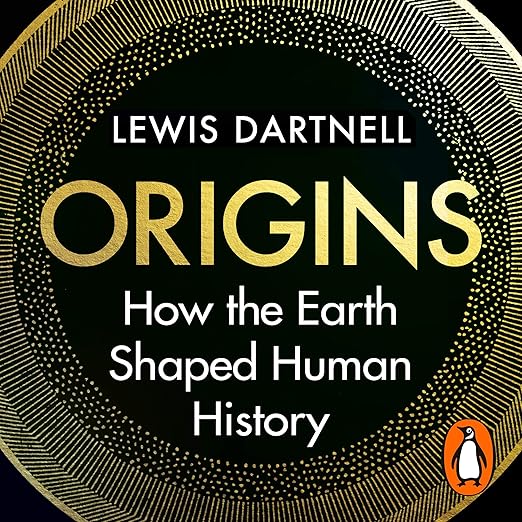
I bought Origins in paperback years ago and read it on a train journey from London to Edinburgh. I remember finding it quietly astonishing: the idea that the shape of the British Isles was influenced by the same geological forces that eventually drove human migration out of East Africa, that these things were connected across billions of years, felt like being handed a new way of seeing everything I thought I already understood. When I returned to it as an audiobook, narrated by John Sackville for Penguin Audio, I found the experience matched the reading almost entirely. This is the rare popular science title that survives the translation to audio with its intellectual atmosphere fully intact.
Lewis Dartnell is a professor of science communication at the University of Westminster, and his previous book, The Knowledge, established him as someone capable of writing about complex systems with unusual clarity and without condescension. Origins is, in some ways, an even more ambitious project: a unified theory of how the physical Earth shaped human history, from plate tectonics through to contemporary voting patterns in the American South.
The Deep Frame Beneath Human History
The central argument of Origins is elegant and genuinely surprising in its implications. When we talk about human history, we typically focus on leaders, ideas, wars, and cultural forces. Dartnell’s contention is that underneath all of those events lies a physical substrate that made them possible, probable, or in some cases practically inevitable. The mountainous terrain of ancient Greece created the conditions for independent city-states and eventually for democratic political theory. The rich alluvial plain of Mesopotamia supported the agricultural surplus that enabled the first complex civilisations. The bed of an ancient inland sea that once covered parts of the American South now traces almost perfectly the boundary between Democratic and Republican voting counties.
The book moves between geological deep time, evolutionary biology, agricultural history, and contemporary geopolitics with the ease of a writer who genuinely believes all these things belong in the same conversation. Some readers have noted that specialists in any of the individual areas covered will find the treatment broad. That is true, and it is the honest trade-off of panoramic popular science: breadth over depth. But the breadth is precisely the point. Dartnell is not trying to tell you everything about any single field; he is trying to show you how the fields connect. Once you have that frame, the individual subjects look different.
At nine hours and nine minutes, the audiobook is a well-paced listen that never lingers too long in any single discipline. The structure moves geographically and temporally in a way that creates genuine momentum: you are always moving toward somewhere new while carrying what you have already learned.
John Sackville and the Weight of Deep Time
John Sackville has been one of the reliable voices in UK popular non-fiction for years, and he brings an appropriate register to Dartnell’s text: measured, clear, engaged without being breathless. This is not a fast-moving thriller that needs urgency; it is an intellectually leisurely argument that benefits enormously from being delivered without rush.
The particular challenge Sackville faces is managing the transitions between geological timescales and human timescales. Dartnell moves frequently between “billions of years ago” and “last century” within the same paragraph, sometimes the same sentence. A less experienced narrator might flatten that contrast or make the shifts feel jarring. Sackville keeps the transitions navigable, using pacing rather than explicit signalling to mark the changes in scale. The Penguin Audio production quality is, as you would expect from that imprint, clean and consistent.
What Readers Say
The Audible UK entry registers only one rating at 4.5, but five detailed written reviews offer more useful guidance. Philip E described it as “the most interesting book I’ve ever read,” pointing to the sweep of its ambition and the capacity to make humanity’s relationship with the physical world feel “awe inspiring.” Book Reader gave it five stars and noted reading it twice. Henry admitted uncertainty before purchasing, then “had difficulty putting it down.” Brian Stuart Peel found the science occasionally tricky but generally accessible, a fair assessment of the book’s register. The only dissenting note came from James-Philip Harries, who found the content “a bit basic” for history enthusiasts while acknowledging Dartnell’s fluency. That is the honest trade-off: a book written for the educated general reader will always cover ground that specialists already know.
Who Should Listen?
Origins works brilliantly alongside books like Jared Diamond’s Guns, Germs and Steel, which covers overlapping territory from a biological and anthropological angle, or Tim Marshall’s Prisoners of Geography, which applies a similar physical-world logic to contemporary geopolitics. Dartnell’s version is particularly strong on deep time and the connections between geological processes and cultural outcomes that most history books ignore entirely.
Not recommended for specialist audiences seeking detailed geological analysis or comprehensive historical coverage of any single period. But for anyone who has wondered why human civilisation settled where it did, why certain cultures developed certain political systems, or why the map of the world looks the way it does, this is one of the most rewarding nine hours you will spend with an audiobook this year.