Clara’s Verdict
I first encountered Alan Watts through a recording that a university friend played in a student kitchen at half past eleven on a Tuesday night, when we were all too tired to do anything useful and somehow not tired enough to sleep. Watts was explaining — effortlessly, warmly, with the kind of casual precision that takes decades to develop — why the self is a fiction we construct and then get trapped inside. I remember everyone in that kitchen going very quiet. That quality is alive on Out of Your Mind, and it has not diminished in the decades since these recordings were made.
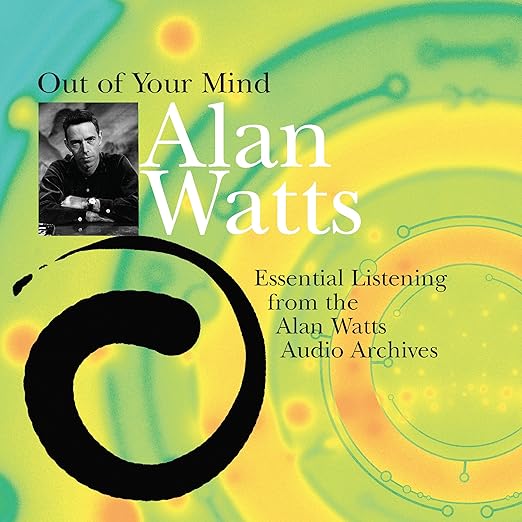
Carrying a 4.7 rating from 860 Audible UK listeners, Out of Your Mind: Essential Listening from the Alan Watts Audio Archives is one of the most highly regarded spiritual audiobooks in its category, and the rating is justified. This is not a book that has been converted into audio. It was always audio: lectures delivered to live audiences, archival recordings selected and digitally restored by Watts’s son and archivist, Mark Watts.
About the Audiobook
Published by Macmillan Audio in October 2015, Out of Your Mind collects twelve teaching sessions spanning six complete seminars. The subject matter ranges across Eastern and Western philosophical traditions: Zen Buddhism, Vedanta, Taoism, and the perennial question of how human consciousness relates to the wider universe it believes itself to be separate from. Watts’s recurring preoccupation — the “skin-encapsulated ego,” as he famously called it — runs through all twelve sessions, approached from different angles and with different conceptual tools.
What makes Watts remarkable as a thinker, and remarkable as an audiobook presence, is that he never seems to be lecturing. He is thinking aloud, following an idea until it reveals something he had not quite expected, drawing the audience with him. The recordings were made primarily in the 1960s, and that context is occasionally audible — there is a particular cultural moment that these seminars belong to — but the philosophical substance is not period-bound. The questions Watts is asking about consciousness, identity, and the possibility of genuine presence in daily life remain as live as they were when he first asked them.
The Narration
Alan Watts is his own narrator in the truest possible sense: these are his original lectures, not a reading of a text. The voice is unhurried, slightly mid-Atlantic in its British-American blend, and possessed of an ease that conveys both authority and genuine pleasure in the material. This is a man who finds his subject inexhaustible, and that delight is audible throughout. The archival quality has been carefully restored — the recordings are clean and the audience presence, where it occurs, adds rather than detracts from the atmosphere. There is no credited narrator as such; Watts himself is the entire experience.
What Readers Say
With 860 ratings and a 4.7 average, Out of Your Mind has accumulated one of the most consistently positive audiences in the spirituality and philosophy category. SteveMK, reviewing with genuine enthusiasm, draws comparisons to Eckhart Tolle, Adyashanti, and Anthony de Mello: “Like Anthony de Mello, Watts had a gift for presenting themes of Eastern spirituality (notably Zen) to a Western audience. Although recorded in the 60s, the wisdom is timeless.” Alan E. Senior calls Watts “one of the great figures of the 20th century who says the unsayable.” Even the more measured responses — Kent Assassin’s “decent” four-star review — acknowledge that what Watts says is “simple and good.” The rarest complaint about this collection is that there are only fourteen hours of it.
Who Should Listen?
Out of Your Mind is well suited to anyone curious about the relationship between Eastern philosophy and Western ways of thinking, to listeners who have found Eckhart Tolle or Ram Dass illuminating and want to hear the intellectual genealogy, and to anyone who has suspected that the way we normally think about selfhood might be a useful fiction that has got somewhat out of hand. It requires no prior knowledge of Buddhism or philosophy. What it requires is a willingness to sit with ideas that do not resolve quickly. Listen on Audible UK for the original archival recordings.