Clara’s Verdict
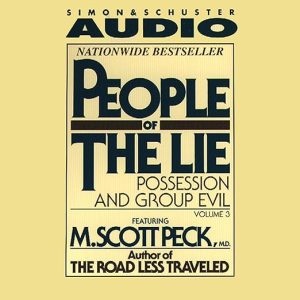
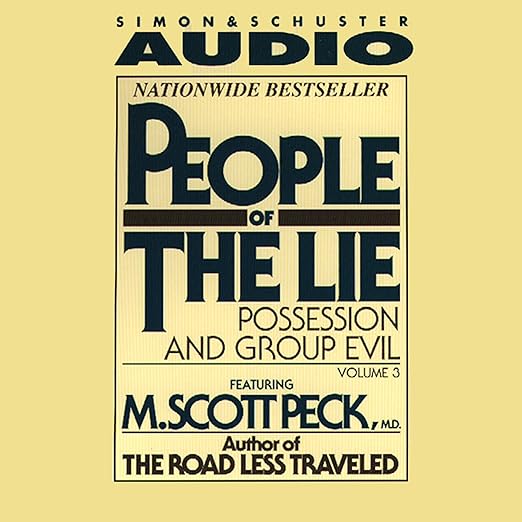
M. Scott Peck’s People of the Lie occupies an unusual space in the self-help and psychology canon: it is a book about evil – specifically, about ordinary human evil, the kind that doesn’t announce itself with obvious malevolence but presents itself as righteousness, as self-protection, as reasonableness. Volume 3 of the audio series ventures into its most challenging territory: possession, exorcism, and the relationship between individual and group evil. This is not comfortable listening. It is, for those who have encountered the phenomenon Peck describes, among the most clarifying things ever written on the subject.
About the Audiobook
Dr Peck was a psychiatrist who spent decades working with patients he came to regard as genuinely evil – not merely disturbed, not merely damaged, but actively engaged in the destruction of others’ well-being while maintaining a rigorous self-image of innocence and virtue. The central insight of the broader People of the Lie series is that evil achieves its most complete form when the person committing it does not perceive themselves as doing so. Evil people, in Peck’s analysis, are defined not by their cruelty but by their refusal to submit to the light of scrutiny – their pathological need to be seen as good.
Volume 3 extends this analysis into group psychology – how organisations and nations can become evil through the same mechanisms, how individuals within groups diffuse moral responsibility until no one is accountable for what all are collectively doing – and into the deeply unfashionable territory of possession and exorcism, which Peck addresses as a psychiatrist who has witnessed things he could not explain by other means. At one hour and twenty-six minutes, this is a short instalment, and serves better as a companion to the earlier volumes than as a standalone work.
The Narration
Peck reads his own work, and the effect is significant. His voice carries the authority and the weight of someone who has spent decades with this material professionally – not performing gravitas but possessing it. There is a quality of quiet urgency in his delivery that suits the subject matter exactly. This is a voice that has listened to a great deal of human suffering and has thought carefully about what it means.
What Readers Say
Reviewers approach this with a range of intensities. Rodney Henchliffe, who has encountered “human evil” personally, described the experience of reading the main book as “both traumatising and remarkable” – “not a book you read; a book you personally relate your experience to.” PatrickHGormley provided a careful summary of Peck’s central thesis: that evil is most dangerous and most complete when the person is unaware they are evil, and that the ordinary presentation of evil – as self-righteousness, as goodness – is its most characteristic feature. Kevin, in a single sentence, called it “the most informative book on malignant narcissism I have ever read.”
Who Should Listen?
This is for anyone who has found themselves unable to understand how someone – a family member, a partner, a colleague – could behave with such apparent indifference to the harm they cause while remaining genuinely convinced of their own virtue. Peck provides a framework, not a solution, but a framework is often the most valuable thing. This is not light listening; it is the kind of book that does serious work if you let it.
Listen to People of the Lie Vol. 3 on Audible UK – a psychiatrist’s account of the dark side of ordinary life, in his own voice, without flinching.