Clara’s Verdict
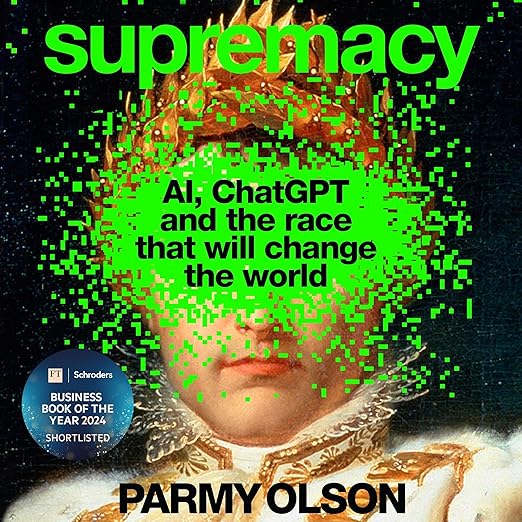
Winner of the Financial Times and Schroders Business Book of the Year 2024, Supremacy by Parmy Olson is the most gripping account yet written of the race between Microsoft and Google to dominate artificial intelligence – and, more specifically, the story of the two idealists at the heart of it who began with the best of intentions and ended up building something that neither of them entirely controls. Olson is a journalist, not a technologist, and that makes her exactly the right person to write this book: she is interested in the human beings, not just the systems.
About the Audiobook
The story begins in the early 2010s with two parallel projects: OpenAI, co-founded by Sam Altman and Elon Musk among others, and DeepMind, the British AI lab founded by Demis Hassabis and eventually acquired by Google. Both were started by people who genuinely believed they were working towards humanity’s benefit. Both were then subject to the gravitational pull of enormous corporate money – Microsoft poured billions into OpenAI, Google into DeepMind – and the question Olson asks, with increasing urgency, is what happened to the original mission when that money arrived.
The book is populated with larger-than-life characters: Musk, who declined DeepMind’s invitation to join and took it personally; Larry Page and Sergey Brin; Peter Thiel. But at its core it is a story about two specific figures – Hassabis and Altman – and the different accommodations they made with corporate power. Olson’s access is remarkable, her prose clear and brisk, and the story she tells carries genuine dramatic stakes. At nine hours and twenty-four minutes, it is the ideal length: thorough without overstaying its welcome.
The Narration
Lisa Flanagan brings exactly the right quality to this material: crisp, authoritative, and paced for information density without ever feeling rushed. Nonfiction narration at this level requires the ability to make technical concepts feel consequential without either oversimplifying or showing off – Flanagan manages both consistently. The passages dealing with the more opaque aspects of large language model development are made genuinely accessible, which is no small achievement.
What Readers Say
The UK response has been enthusiastic and broadly consistent: readers find it accessible, gripping, and essential. Alex called it “superbly well-written” and said it explains “both the strategic and nuanced problems of AGI in a digestible way that doesn’t require a PhD in Neural Networks.” Garrett McQuaid recommended it for beginners and regular AI readers alike. J. Drew provided a careful summary of its central argument – “how two individuals helped ignite a technological revolution, and how the giants of corporate power quickly moved in to shape and control its future” – that captures the book’s argument precisely.
Who Should Listen?
Essential for anyone working in technology, finance, policy, or any field where AI is reshaping working life – which is to say, most fields. But it is also a compelling narrative for general readers who want to understand the forces that have so rapidly transformed public life. You do not need technical background; what you need is an appetite for a good story about ambition, money, and the distance between intentions and outcomes.
Listen to Supremacy on Audible UK – the story behind the technology reshaping the world, told by one of the best journalists covering it.