Clara’s Verdict
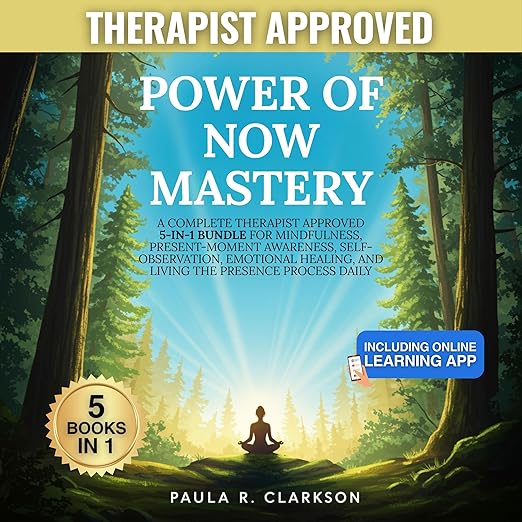
The “present moment” space in audiobooks is, to put it charitably, crowded. Eckhart Tolle planted a flag there in 1997 and has been followed by several hundred books making broadly similar claims with varying degrees of coherence and practical usefulness. Paula R. Clarkson’s Power of Now Mastery distinguishes itself in two meaningful ways: it is approved by a certified psychotherapist (Annaliese Arthur, IAOTH), and it is explicitly rooted in therapeutic practice rather than spiritual aspiration. The distinction matters. This is not a book about achieving a mystical state; it is a structured programme for building attention habits that survive contact with an actual working life – one with deadlines, family obligations, and a mind that does not conveniently switch off when asked.
At three hours and forty-three minutes, it is also concise enough to be genuinely useful, which is a rarer quality in this genre than it should be. The 28-chapter structure means it works both as a complete listening experience and as a reference you can return to selectively.
About the Audiobook
Power of Now Mastery is organised as a six-part, 28-chapter system covering everything from understanding why the mind resists presence to practical techniques for managing anxiety, work stress, and the dreaded “3 AM mind” – the thoughts that arrive when you cannot sleep and feel enormous in the dark. What sets it apart from most mindfulness audiobooks is the scaling of its exercises: practices are offered in 2-minute, 5-minute, and 10-minute formats, acknowledging that not everyone has the luxury of a daily hour-long meditation session. This is a book written for the way people’s lives actually are, not for the way wellness culture imagines them to be.
There is also a 30-day challenge built into the later sections, providing a progressive skill-building structure for those who want to use the audiobook as a genuine course rather than background listening. The accompanying PDF is available in your Audible Library. The psychotherapist endorsement is not merely decorative: the content is genuinely grounded in evidence-based techniques drawn from Acceptance and Commitment Therapy and mindfulness-based cognitive approaches. Published in March 2026.
The Narration
Kevin Wagner narrates, and he brings a composed, reassuring quality to the material that suits it well. This is not a performance that demands attention through vocal energy; instead, it invites a certain settling, which is appropriate for a book about the practice of presence. The pacing is unhurried without being soporific – a balance that is harder to achieve than it sounds when you are recording material about slowing down and paying attention. The 28 chapters are each reasonably self-contained, making the audiobook easy to revisit selectively when you need a particular technique rather than the whole framework.
What Readers Say
As a March 2026 release, listener data is at an early stage, but the structural approach has strong precedent in the therapeutic mindfulness space. The psychotherapist endorsement and the explicitly non-spiritual framing are likely to attract listeners who have found other present-moment books too vague, too mystical, or too abstract to be of practical use. The 30-day challenge structure adds an accountability element that casual mindfulness reading characteristically lacks: it gives listeners something to do with what they have heard, which is ultimately what separates useful self-development content from interesting self-development content.
Who Should Listen?
People who have read or heard about present-moment awareness – perhaps through Tolle or through a mindfulness course – but have struggled to make the practice stick in their actual lives. Those dealing with work stress, anxiety, or a persistently busy mind who want a practical toolkit rather than a philosophy. Anyone who found conventional mindfulness courses unhelpfully abstract and wants something grounded in therapeutic principles and scaled for real time constraints. The 30-day challenge structure also makes this appropriate for those who know they need external scaffolding to build new habits rather than simply good intentions and an open afternoon.
The psychotherapist endorsement is worth taking seriously. Annaliese Arthur (IAOTH) has reviewed the content and found it consistent with therapeutic principles – which means that someone with clinical training has assessed whether the techniques described are likely to be useful or potentially harmful for people dealing with anxiety. This kind of independent review is rare in the wellness audiobook space, where most content is self-declared as evidence-based without any external validation. Here, it has actually been checked.
There is also something practically useful about the 28-chapter structure that goes beyond simple organisation. Each chapter addresses a specific problem or technique, which means the audiobook can function as a reference work after the initial listening. When you find yourself caught in the “3 AM mind” spiral three months after finishing the course, you do not need to relisten to everything – you can find the relevant section and work with it directly. That kind of re-usability is rare in audio, and it significantly extends the value of the purchase.
Start building genuine presence with Power of Now Mastery on Audible UK – listen here.