Clara’s Verdict
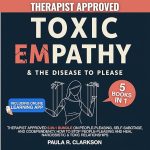
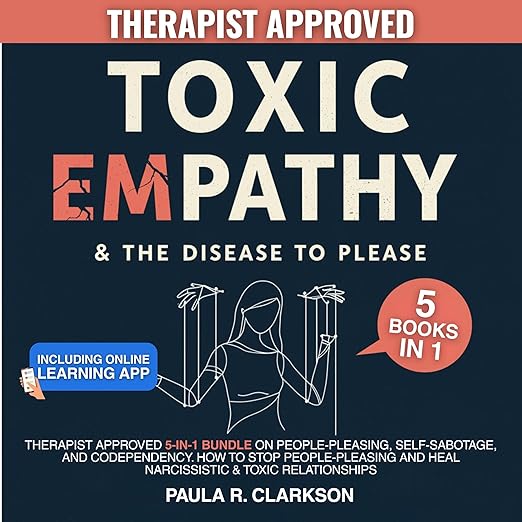
There is a particular kind of exhaustion that comes not from overwork but from over-giving – from spending every waking hour attuned to everyone else’s needs while quietly losing track of your own. Toxic Empathy & the Disease to Please by Paula R. Clarkson is one of those rare self-help audiobooks that actually names this experience with precision, rather than simply urging you to “set better boundaries” and leaving you to work out the mechanics yourself. Narrated by Gerhard Weigelt in a measured, unhurried tone, this is a genuinely useful listen for anyone who recognises themselves as a habitual people-pleaser – and is finally ready to do something about it.
I’ll be direct: the self-help market is flooded with titles on codependency and empathy burnout, and most of them recycle the same advice. What makes this one worth your time is its structural rigour. The 24-chapter roadmap across five parts moves you from diagnosis to daily practice without ever feeling rushed or superficial. That’s harder to pull off than it sounds.
About the Audiobook
Clarkson’s core argument is that empathy – one of our most admirable human qualities – can become a wound when it is deployed compulsively, without boundaries, as a way of managing anxiety or seeking approval. The book is approved by certified psychotherapist Annaliese Arthur (IAOTH), which lends the content a therapeutic credibility that many comparable titles lack.
The 3.5-hour listen (with an accompanying PDF available in your Audible library) covers the full arc of recovery: understanding the childhood roots of people-pleasing, recognising the fawn response in your own body, learning to regulate your nervous system, and ultimately redesigning your relationships from a place of authenticity rather than fear. There are concrete boundary scripts – word-for-word language for the difficult conversations that most of us would rather avoid – alongside nervous system regulation techniques drawn from somatic therapy. It is practical in a way that genuinely earns that word.
The book is structured as a five-part journey: from identifying the patterns, through understanding their origins, to building a new way of operating in the world. Each chapter is actionable rather than merely inspiring, which is the distinction that separates useful self-help from motivational filler.
The Narration
Gerhard Weigelt brings a calm, grounded presence to the material – exactly the right register for a book about nervous system regulation and emotional healing. His pacing is deliberate without being slow, and he handles the more vulnerable passages – descriptions of the fawn response, of childhood conditioning – with care and respect. There is nothing performative about his delivery, which suits the tone of the writing perfectly. For a book asking you to slow down and listen to yourself, having a narrator who embodies that quality is no small thing.
What Readers Say
This is a newer release and does not yet carry a significant volume of public reviews, but it arrives with a therapist endorsement and a detailed, evidence-based structure that speaks for itself. The concept of “toxic empathy” – the idea that over-giving can be as damaging as withholding – is one that resonates deeply with readers working through codependency, anxiety, or burnout. Books in this space consistently attract listeners who describe them as transformative, and the specificity of Clarkson’s approach – nervous system tools, boundary scripts, generational cycle work – positions this as a more actionable entry than most.
Who Should Listen?
If you have spent years putting everyone else first and are beginning to suspect that this is not a virtue but a pattern – one rooted in fear rather than genuine generosity – this audiobook is for you. It will be particularly useful for people navigating codependent relationships, recovering from emotionally demanding family dynamics, or dealing with anxiety that manifests as an inability to disappoint others. At under four hours, it is a focused, efficient listen that repays repeated attention.
Listen to Toxic Empathy & the Disease to Please on Audible UK – and start giving yourself a fraction of the care you have always given everyone else.