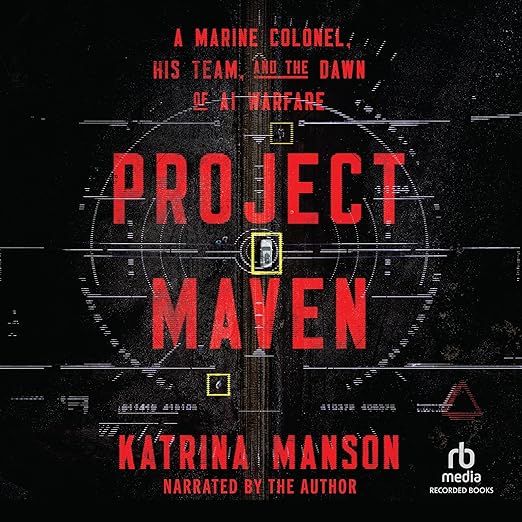
Clara’s Verdict
I finished Project Maven on a Friday evening and sat with it for a while afterwards, which is usually a good sign. Katrina Manson, the Financial Times’s former Washington bureau chief and national security correspondent, has written a book that is simultaneously a narrative history, a reported investigation, and a genuine reckoning with what it means to delegate the decision to kill to algorithmic systems. The subject demands exactly this kind of treatment: rigorous, specific, and unwilling to settle for either techno-optimism or technophobia.
Self-narrated and published by Recorded Books in March 2026, this runs to 13 hours and 30 minutes. The listener rating stands at a perfect 5.0 from 2 reviews, which is a very small sample but a consistent signal. For a book of this kind, early specialist readers tend to be well-calibrated; this is not the sort of title that attracts inflated reviews from casual fans.
About the Audiobook
Published on 24 March 2026, Project Maven tells the story of a programme that began in 2017 when a small crew gathered in a windowless Pentagon room to put artificial intelligence at the heart of how America makes war. The book draws on more than 200 interviews with Project Maven insiders and opponents, which gives it an unusual density of primary source material. Manson traces the programme from its origins under a Marine Corps colonel haunted by the deaths of US troops, through its controversial enlisting of Silicon Valley, through the internal Google employee revolt that resulted in the company withdrawing from the contract, and into the current state of AI-enabled operational deployment.
One of the book’s important contributions is its account of why Silicon Valley’s initial participation was reluctant rather than enthusiastic. The internal dynamics at Google, where employees organised against the project and eventually forced the company’s withdrawal, represent a moment that has had lasting consequences for the relationship between the technology industry and the defence establishment. Manson covers this episode with the depth it deserves rather than treating it as a side note to the main military narrative.
The narrative moves with the urgency of a tech startup story, which is clearly a deliberate choice. Manson is attuned to the culture of the people driving this technology. She renders the Pentagon bureaucracy, the competing personalities, and the military-Silicon Valley friction with considerable vividness. The book does not sanitise the stakes. It explains clearly what these targeting systems were designed to do, how they were tested in live operational contexts, where they succeeded, and where they failed. The final sections, on how Maven’s lessons are being folded into autonomous systems being developed for future conflict, are sobering in a way that stays with you.
The Narration
Manson’s self-narration is a significant asset here. Her background as a broadcast journalist means she reads with authority and fluency, and her familiarity with the material means she can navigate acronyms, technical terms, and the names of military programmes without the hesitancy that sometimes afflicts authors reading their own work. The tone is measured and serious without becoming arid, even across 13 hours of dense material.
The journalistic prose translates cleanly to audio. Chapters are clearly demarcated and the structure is logical enough that listeners can follow the chronological and thematic threads without losing their footing. For a subject this complex, the clarity of the narrative organisation is itself an achievement.
What Readers Say
With only two reviews, the sample is limited, but both are substantive. One listener described it as exceptionally written and hard to put down, and praised its grounding in firsthand reporting and unprecedented access. The same reviewer noted its relevance for audiences ranging from the merely curious to the specialist, and called the real-life examples of AI development and deployment in a military context both fascinating and essential. The consistency of the 5-star response from those who have encountered it suggests it is landing well with exactly the audience it is aimed at.
Given the recency of publication and the specialised subject matter, the low review count is not a quality signal. Books of this kind tend to build their readership slowly and steadily, through word of mouth in policy, technology, and journalistic communities, rather than through rapid social media traction.
Who Should Listen?
Essential listening for anyone interested in the intersection of technology and geopolitics, military ethics, or the specific history of how AI moved from science fiction to operational deployment. This will also appeal to readers of books such as Amy Zegart’s Spies, Lies, and Algorithms or Fred Kaplan’s The Bomb. Those who want a human-interest narrative around technological change rather than a technical treatise will find the storytelling accessible and propulsive. Listeners expecting a polemic, either for or against AI in warfare, will find something considerably more nuanced and therefore more useful.
Project Maven is available on Audible UK. Listen on Audible UK