Clara’s Verdict
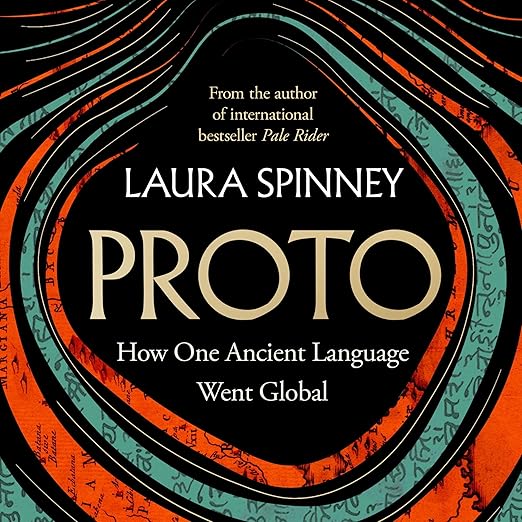
I studied linguistics briefly as a postgraduate student, and the question of where languages come from, not in the individual sense of vocabulary acquisition but in the deep historical sense of common ancestry, has stayed with me ever since. Proto is the book I would have pressed into the hands of every student I knew had it existed then. Laura Spinney has written something genuinely beautiful here: a book about a dead language that reads like a thriller about origins.
The central insight is both simple and staggering. Nearly half of humanity speaks a language descended from a single proto-tongue spoken roughly five thousand years ago on the Eurasian steppe. The fact that English star, Icelandic stjarna, and Iranic stare all carry traces of the same ancient word is not mere etymological trivia: it is a clue to one of the most consequential migrations in human prehistory.
About the Audiobook
A Guardian, New Statesman, Prospect, and Waterstones Best Book of 2025, published by William Collins and running 9 hours and 3 minutes. Spinney is an acclaimed journalist, best known for Pale Rider, her history of the 1918 influenza pandemic, and she brings the same quality of synthesis to this project: the ability to hold together strands of linguistics, archaeology, and genetics without losing either the narrative thread or the reader’s trust. The book takes you across the Caucasus, the Silk Roads, and the Hindu Kush, following the linguistic diaspora that shaped every Indo-European language in existence. New Scientist described it as a magisterial feat; The Guardian called it a revelatory portrait of world history in its own words. 580 ratings averaging 4.6 stars is a significant audience for a work of popular linguistics.
The Narration
Emma Spurgin Hussey narrates, and she handles the dense and varied material with considerable skill. One reviewer notes with some frustration that she struggles with certain Irish names, a fair point in a book that ranges across dozens of language families, and one that producers should take note of for future editions. The overall performance is clear, measured, and never condescending, which are the right qualities for complex material aimed at a general audience.
What Readers Say
The response has been warm and substantive. Listener Ian Ayling highlights the intersection between linguistics and genealogy as the book’s particular strength, noting that it allows the mapping of language development with more clarity than ever before. Alison Mold appreciates the depth while noting occasional syntactic complexity in Spinney’s prose. The critical note about the narrator’s pronunciation of Irish names is specific and useful feedback rather than a general complaint.
Who Should Listen?
Anyone with genuine curiosity about where language comes from, and anyone who has enjoyed popular history or science at the level of Sapiens or The Gene. This rewards patient listening and a willingness to absorb new proper nouns and linguistic terminology: it is not a light listen. But the rewards are considerable. By the end, you will hear something different every time you recognise a word shared across seemingly unrelated languages.