Clara’s Verdict
There is a reason books about attention and mental clarity keep appearing on publishing lists with considerable regularity: because the problem they describe keeps getting worse, and each new iteration of the proposed solution reaches a slightly different reader at a slightly different moment in their evolving relationship with distraction. We are, collectively and individually, not getting better at this. The tools designed to help us have themselves become sources of the problem, and the genre that promises to address that paradox is not going away because the paradox is not going away either.
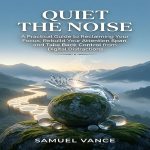
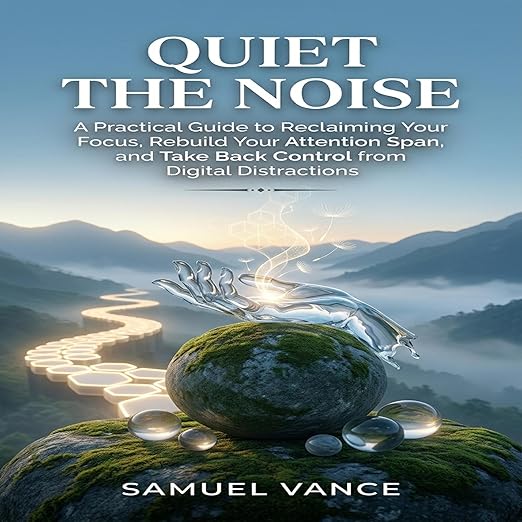
Quiet the Noise by Samuel Vance is a compact, practical audiobook – just over an hour – that positions itself at the accessible, actionable end of this genre rather than the research-heavy or philosophically ambitious end. It is not attempting to be Johann Hari’s Stolen Focus or Cal Newport’s Deep Work: those books are longer, more comprehensively argued, and doing different work. Quiet the Noise is attempting to give you something you can act on today, with enough scientific grounding to explain why the strategies work without the grounding overwhelming the practical application. Released March 2026, published by MISHA WELLIUM MAX, narrated by Elizabeth Stockton. No Audible UK ratings yet.
About the Audiobook
Vance opens with what he calls the biology of distraction: an accessible account of how human attentional systems were not designed for the density and frequency of stimulation that contemporary digital life provides, and how the attention economy has been deliberately engineered to exploit the specific vulnerabilities of those systems for commercial ends. The hidden cost of multitasking receives particular attention – the cognitive switching costs that accumulate invisibly across a working day, leaving most people feeling simultaneously perpetually busy and persistently unproductive, unable to locate the gap between the activity and the achievement.
From this diagnostic opening, the book moves with commendable directness into practical territory: auditing your digital habits with honesty rather than defensiveness, designing what Vance calls a low-distraction environment through deliberate choices about notification architecture and workspace design, rebuilding attention span through deliberate practice rather than willpower alone, and setting functional boundaries with both technology and the social demands of always-on communication. The framing throughout is science-backed but kept light enough that the science serves the strategies rather than interrupting them. Vance’s tone is described as clear, relatable, and highly practical – qualities that matter considerably in a genre where books can easily tip into either academic inaccessibility or the breezy shallowness that changes nothing. Whether Vance achieves the balance consistently is what listener reviews, as they accumulate, will confirm.
The Narration
Elizabeth Stockton’s narration is well-suited to a book about mental clarity and intentional attention. Her delivery is calm and unhurried – she reads at the kind of pace that allows information to settle properly in the listener’s mind rather than accumulate as undifferentiated content, which is a pleasingly apposite quality for a book explicitly concerned with reducing cognitive overload rather than adding to it. At just over an hour, her performance has no opportunity to drift, and she maintains a consistent quality of engaged presence throughout. The audio production is clean, which matters in a format you are likely to encounter through headphones on a commute or walk.
What Readers Say
No Audible UK reviews are available for this March 2026 release at the time of writing. The book occupies a well-populated niche, and its success in finding an audience will depend substantially on whether its practical frameworks translate into genuine behavioural change for the listeners who try them. A book about attention that does not actually improve your attention is a failure at the most basic level of its promise, and readers in this genre have been through enough cycles of enthusiasm and disappointment to have developed a fair amount of justified scepticism. The self-published origin and compact runtime mean word-of-mouth recommendation will be the primary discovery mechanism – the kind of book someone forwards to a friend with a note that says: it’s only an hour, just listen.
Who Should Listen?
This is for anyone who recognises their attention as something that has been gradually and perhaps irreversibly eroded, and who wants a short, practical framework for beginning the process of reclaiming it. It will suit professionals who feel persistently reactive rather than intentional in how they allocate their working hours, students who find sustained study genuinely harder than it seemed a few years ago, and anyone who has noticed that reading a long article or a book chapter for more than twenty minutes requires a degree of effort it did not used to require. For those wanting a deeper, more thoroughly researched treatment of the same territory, the longer books in the genre offer more. But as a starting point – a focused 64-minute investment that might move someone from awareness of the problem to the beginning of a practical response – Quiet the Noise earns its compact and intentional runtime. Listen on Audible UK