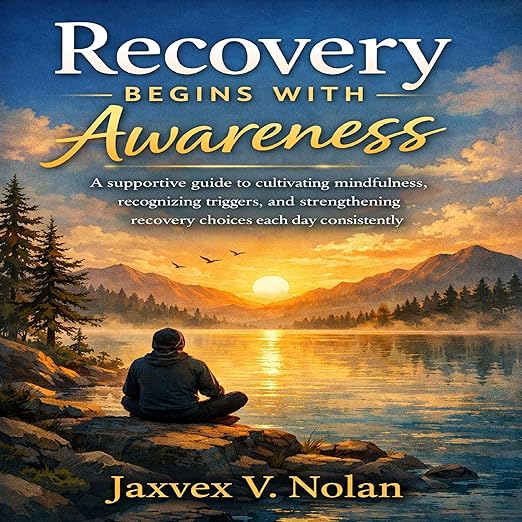
Clara’s Verdict
Recovery Begins with Awareness occupies a specific and genuinely useful niche: a short, practical guide to the role of self-awareness in addiction recovery, written without clinical coldness and without the soft-focus inspirational vagueness that weakens many books in this space. Jaxvex V. Nolan’s approach is grounded in recognisable psychology – mindfulness, trigger mapping, thought reframing – and presented in a manner that feels accessible at any stage of the recovery process. Robyn Green’s narration is warm and non-judgmental, exactly the register the material requires. At three hours, this is a genuinely manageable listen that could be returned to repeatedly rather than consumed once.
About the Audiobook
The book’s central argument is that lasting recovery is not primarily about willpower or cessation of substance use but about cultivating a kind of conscious attention to one’s own internal world – an awareness of thoughts, emotional patterns, triggers, and the automatic behaviours through which addiction maintains itself. Nolan begins by contextualising addiction as a response to pain, stress, or unmet need, explaining how the cycle of use becomes self-reinforcing through habit and avoidance. He then introduces awareness as the intervention that disrupts that cycle.
The practical portion of the book is its strongest element. Nolan offers specific exercises: journaling practices, breath awareness, trigger mapping, thought reframing techniques. These are presented with appropriate care – not as magic solutions but as consistent practices that build skill over time. He is also good on the obstacles: denial, shame, fear of what awareness might reveal. His treatment of setbacks is particularly valuable; rather than framing them as failures, he positions them as occasions for learning – a reframe that requires more psychological work than the framing suggests but is genuinely worth attempting.
The book is honest about what it is: an introduction, a foundation, a starting point. It does not replace therapy or medical support. But for someone in early recovery, or considering recovery, or supporting someone through it, three hours of this kind of careful, compassionate thinking offers genuine value.
The Narration
Robyn Green’s performance is well-calibrated for the material. Recovery-focused content requires a voice that is neither clinical in its detachment nor effusively positive in the mode of a wellness influencer. Green occupies the appropriate middle ground: present, warm, and reassuring without minimising the difficulty of what she is discussing. The pacing is careful – slightly slower than a standard narration – which suits both the subject matter and the practical exercises. A thoughtful reading of a thoughtfully written book.
What Readers Say
This March 2026 release is still accumulating listener reviews. For a book of this nature – focused on recovery and self-awareness rather than entertainment or narrative – reader feedback often takes time to gather, as it tends to come from people engaging with the material at vulnerable moments rather than those rating books casually. The book’s emphasis on practicality and its non-judgmental tone are its most consistently noted qualities in early responses. Its brevity – under three and a half hours – makes it particularly approachable for listeners who might struggle to sustain engagement with a longer, more demanding text.
Who Should Listen?
For anyone at any stage of the recovery journey from addiction, whether their own or a family member’s. Also genuinely useful for counsellors, therapists, and support workers looking for a resource to recommend to clients exploring the emotional dimensions of their recovery. The mindfulness and self-awareness framework will also appeal to listeners with a general interest in the psychology of habit and change, even outside the context of addiction. Compassionate, practical, and honest about its own scope.