Clara’s Verdict
Harari builds his book on one humbling piece of arithmetic: Earth has existed for 4.5 billion years, and in a barely measurable fraction of that time a single species, ours, has conquered the lot. Sapiens sets out to explain how that happened, and it does so with a confidence I found equal parts thrilling and maddening. Harari keeps two questions in constant tension, what makes us brilliant and what makes us deadly, and he refuses to let you settle comfortably on either side of that ledger. My honest verdict: this is essential listening, but it is not cautious listening. Harari paints in enormous strokes, and specialists will quarrel with plenty of them. Accept that going in and the hours fly past; expect a hedged academic survey and you will spend the whole recording arguing with your headphones.
What This Edition Is and Who It’s For
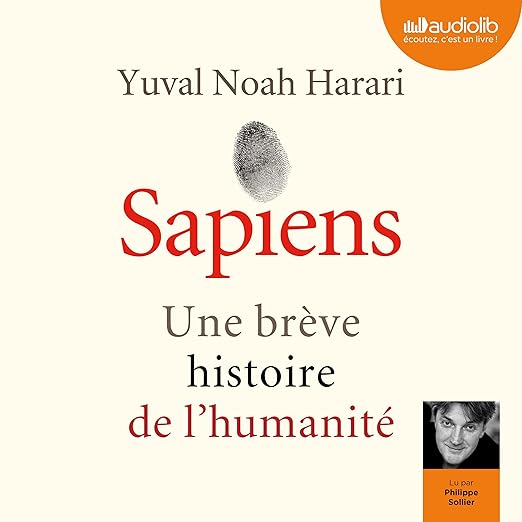
This is the unabridged English audiobook of Sapiens, published by Vintage Digital, released on 30 April 2015 and running 15 hours and 18 minutes. It belongs to Harari’s A Brief History Series, and it remains the book that made his name. The Guardian placed it among the hundred best books of the 21st century, and its admirers are not short of stature: Barack Obama found it interesting and provocative, Bill Gates recommends it to anyone curious about the history and future of our species, and Chris Evans went as far as calling it possibly the best book he has ever read.
What you actually get as a listener is one continuous argument, carried from our species’ obscure beginnings through to some genuinely unsettling questions about where we are heading. It sits at the junction of history, politics and science, and it rewards anyone who enjoys watching those three subjects collide.
Derek Perkins and the Art of the Long Argument
Nonfiction on this scale lives or dies by its narrator, and Derek Perkins is a superb match for Harari. His delivery is measured and beautifully clear, with the poise of a lecturer who knows the material cold and never needs to raise his voice to hold the room. What I admire most is his handling of Harari’s dry provocations: they land precisely because Perkins declines to oversell them, letting a small shift of tone do the work while the words stay level. Over more than fifteen hours he keeps the thread of the argument taut, so an idea planted in the early chapters still rings clear when Harari circles back to it near the end. If long nonfiction usually loses you somewhere in the middle, this is the kind of narration that solves the problem.
What Readers Say
Listeners have taken to this recording with real enthusiasm: it holds a 4.6-star average across 131 ratings. One listener noted that it is “the kind of book that makes you look at everything differently”, which matches my experience almost exactly. Another admired the way Harari urges his audience “to question the basic narratives of the world”, tackling awkward subjects head on rather than tiptoeing around them. The dissent is worth hearing too: one four-star reviewer described the book as “an intriguing and thought provoking liberal view of mankind’s history”, a fair reminder that Harari’s framing carries a point of view. Even that sceptic, note, still found it intriguing.
Who Should Listen?
Listen if you want a big-ideas companion for commutes and long walks, if you like history that argues rather than merely recounts, or if you have been meaning to read Sapiens for years and never quite managed it in print; the audio is the easiest door in, and Perkins holds it open. It also makes superb book-club material, because nearly every chapter hands you something to disagree about.
Skip it if what you want is narrow, heavily hedged scholarship on a single period, or if sweeping claims about human nature set your teeth on edge, because Harari provokes on principle. Everyone else should give the first hour a try. I suspect that, like me, you will not stop there.