Clara’s Verdict
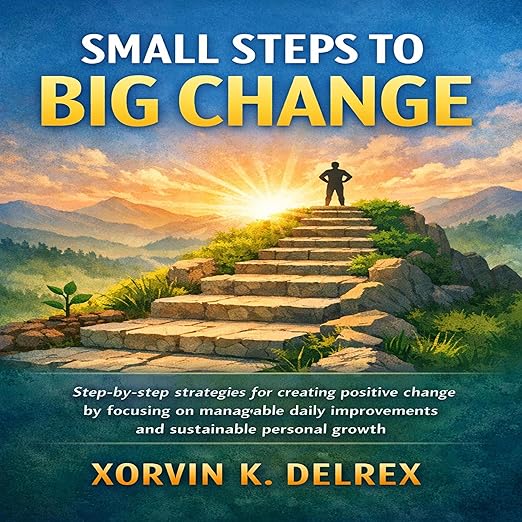
The self-help genre’s central and persistent problem is that it tends to promise dramatic transformation through heroic effort, which is the opposite of what most people can actually sustain beyond the first three weeks of January. Small Steps to Big Change by Xorvin K. Delrex takes a different line: lasting change is quiet, cumulative, and built on systems rather than willpower. That argument is not new – James Clear made it to considerable commercial effect in Atomic Habits, and Charles Duhigg made it before him – but Delrex’s treatment is its own thing, particularly in its honest attention to identity and self-doubt as barriers that habit literature often acknowledges briefly and then fails to address in any practical way.
I am more interested in this book than I might have expected to be, partly because of what it does not do. It does not open with a dramatic personal story of transformation. It does not introduce a proprietary acronym system. It does not claim to be the last habit book you will ever need. It simply makes a clear, structured argument about how change actually works and offers practical tools for applying it. That restraint, in a genre that rewards maximalism, is quietly distinctive. At just over three hours, it is also one of the most concise entries in the field, which is itself a kind of argument about what is necessary.
About the Audiobook
The book is carefully organised around the well-established psychology of behaviour change – how habits form neurologically, why they break down despite genuinely good intentions, and what consistently distinguishes sustainable long-term progress from the familiar burst-and-crash cycle that most people recognise from their own self-improvement attempts. Delrex draws on concepts from behavioural science without leaning heavily on academic citation, which makes the listening experience accessible rather than academic. The focus on identity – the argument that small consistent actions gradually reshape who you believe yourself to be, and that this matters as much as the actions themselves – is the most interesting thread and the one most worth returning to.
Where the book earns its keep is in its honest address of common failure modes: the paralysis that comes from trying to change too much simultaneously, the shame that follows setbacks and compounds the problem by creating avoidance, the way perfectionism masquerades as high standards while actually preventing any meaningful standards from being met. These are handled practically and specifically, with short applied exercises embedded directly in the chapters rather than appended as an afterthought. The emphasis throughout is on recovering quickly from the inevitable interruptions to progress rather than on achieving unbroken streaks – which is, again, more honest than most of the competition.
The Narration
Robyn Green narrates with a clear, even delivery that suits the material’s quiet confidence. The tone is encouraging without tipping into the relentlessly upbeat register that plagues much self-help audio – Green understands that the audience for this kind of book is often genuinely struggling with something specific, and she does not condescend to them with performed enthusiasm or forced warmth. There is a measured quality to her reading that mirrors the book’s own argument: consistent, unhurried, building rather than surging. At just over three hours, the pacing is brisk, which is entirely appropriate for a book whose central argument is about doing small things consistently rather than mounting dramatic, exhausting gestures. The production throughout is clean and professional.
What Readers Say
This title is recently released from a smaller independent publisher and does not yet carry listener reviews. As early word-of-mouth builds, the approach it takes – modest, specific claims rather than transformational promises, a clear framework, a short runtime that respects the listener’s existing commitments – positions it well for readers who have been disappointed by the overreach of bigger self-help titles. The absence of a celebrity author name may limit its initial visibility, but the content is solid enough to build its audience through genuine recommendation.
Who Should Listen?
Anyone who has started a self-improvement project, maintained it for three weeks, and then abandoned it when life inevitably intervened. Which is to say, most of us, most of the time. The short runtime makes it easy to fit around a busy schedule, and the absence of elaborate systems or proprietary jargon means the ideas stay practically accessible. For listeners who have already absorbed Atomic Habits or The Power of Habit, this will feel like familiar territory covered with a usefully different emphasis on the emotional and identity dimensions of habit formation; for those coming to the subject entirely fresh, it is a solid, honest, and admirably concise introduction to how behaviour change actually works in practice.
Listen to Small Steps to Big Change on Audible UK – practical habit-building without the dramatic promises.