Clara’s Verdict
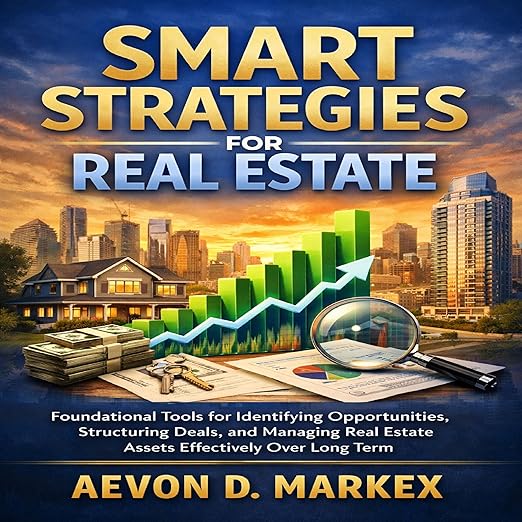
There is a particular kind of audiobook in the personal finance space that promises transformation and delivers platitudes. Smart Strategies for Real Estate by Aevon D. Markex is, to its credit, more disciplined than that. I listened to it over the course of a train journey from London to Edinburgh, and while I would not call it revelatory, it is a functionally solid guide to the strategic thinking that separates sustainable property investors from those who get burned by a market correction. For listeners new to real estate as an investment vehicle, the clarity here is genuinely useful.
What Markex does well is insist on treating property investment as a business rather than a windfall scheme. That sounds obvious on paper, but the audiobook landscape is littered with titles that dress speculation up as strategy. This one does not, and the restraint is appreciated. The tone throughout is that of a practitioner who has watched both careful and careless investors and drawn sensible conclusions from the comparison.
About the Audiobook
Running to three hours, the book covers market analysis, property evaluation, financing structures, and risk management in the first half, before turning to execution: offer strategy, negotiation, property management, and performance monitoring. There is also a useful section on adaptability, which addresses how investors should respond to economic cycles, demographic shifts, and regulatory change rather than assuming conditions remain static.
The framing is consistently long-term. Markex is not interested in flipping or quick gains; the book is built around the premise that value is created through discipline and operational rigour over time. The chapter on data-driven decision-making is one of the stronger sections, offering a clear framework for evaluating opportunities without falling into the trap of emotional attachment to a property or a neighbourhood. He is particularly clear on how to assess risk objectively, which is where many beginning investors go wrong.
The writing is businesslike throughout. Markex does not waste words, and the structure, moving logically from analysis to acquisition to management, means listeners always know where they are in the argument. Published by Zac Goldrick in March 2026, the book feels current in its awareness of changing market conditions, though specific market figures are not cited extensively, which keeps it from dating quickly.
There is a section on the psychological side of investing that deserves mention. Markex spends time on the discipline required to remain objective when markets move against you, and on the danger of anchoring to a projected valuation that external conditions have rendered obsolete. It is the kind of material that experienced investors will recognise and novices genuinely need to hear.
The Narration
Robyn Green’s narration is professional and composed. Her tone is appropriately businesslike without being cold, and she handles the more technical passages on financing structures and risk frameworks with authority. This is not a performance that calls attention to itself, which is exactly right for the material. Green lets the content lead and resists the temptation to inject false enthusiasm into what is fundamentally a practical guide. Her pacing is well-suited to a three-hour listen that asks listeners to retain frameworks rather than simply absorb atmosphere.
What Readers Say
As a March 2026 release, Smart Strategies for Real Estate has not yet accumulated listener reviews. This is a self-published title still building its audience, and the absence of feedback should be read as newness rather than indifference. The book will need time to find the property investment community it is clearly aimed at.
Who Should Listen?
This book is best suited to listeners who are approaching property investment seriously for the first time, or to those who have made one or two purchases based on instinct and want a more structured framework going forward. Experienced investors will likely find the foundations familiar. The three-hour format makes it a manageable single-session listen, appropriate for its scope. Those looking for UK-specific guidance on stamp duty, buy-to-let regulations, or leasehold complexities will need to supplement it with locally focused material, as the book operates at the level of general strategic principle rather than jurisdiction-specific detail.