Clara’s Verdict
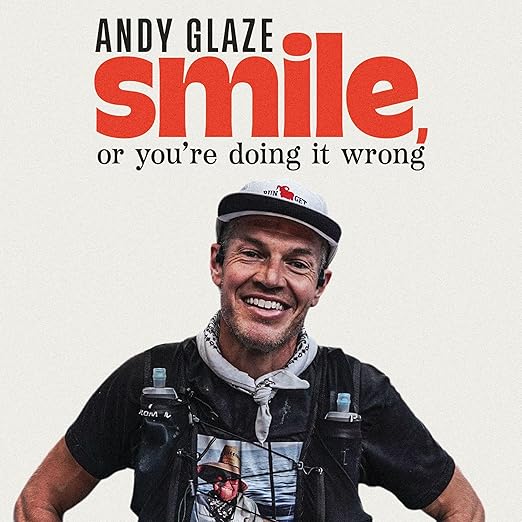
There is a very specific type of memoir that I find myself returning to: the kind where the author does not present their suffering as a credential but as a starting point, the kind that insists on forward motion without pretending the ground behind it was not genuinely treacherous. Andy Glaze’s Smile, or You’re Doing it Wrong is that kind of memoir. He survived a wilderness rehabilitation programme where adolescents hiked for days without food, and a therapeutic boarding school he describes as being run by predators. He then became a firefighter, a father, and an ultrarunner of considerable dedication. The book moves through all of that without tipping into either trauma tourism or inspirational cliche, and that is a harder balance to maintain than it looks.
The ultrarunning frame is doing important work here. The physical discipline of hundred-mile races gives Glaze a language and a structure for talking about recovery and forward motion that never requires him to become abstract about either. Running as metaphor is well-trodden literary ground, but Glaze earns it through specificity: the actual ache, the actual distance, the actual commitment to the next step when the next step is the only thing you can manage. The memoir’s title, apparently a mantra that travels with him into races and into daily life, is both instruction and philosophy: not toxic positivity, but a genuine commitment to choosing forward.
About the Audiobook
Published by Fedd Books in March 2026 and running to seven hours and fifteen minutes, Smile, or You’re Doing it Wrong is Andy Glaze’s account of a childhood marked by institutional abuse and addiction, and the life he built on the far side of it. The memoir moves through his experiences in the wilderness rehab programme and the therapeutic boarding school, through his years fighting fires and raising a family, and into his identity as an endurance athlete who has translated the hardest lessons of his early life into a philosophy of sustained forward movement.
The book has no series context; it is a standalone memoir. At seven hours it is a focused listen, fitting comfortably within a single sitting or two sessions, and the pacing reflects Glaze’s background in environments where brevity and clarity are survival tools rather than stylistic preferences. The absence of self-pity throughout is, given the material, remarkable, and it is the book’s defining quality.
The Narration
Glaze narrates his own memoir, and the reader response makes clear this is a significant part of the book’s impact. One reviewer specifically noted that the material is even better to listen to in the writer’s own voice, the directness and warmth that characterise the memoir amplified when it is Glaze himself delivering them, without the mediation of a third-party performance. For a memoir dealing with institutional abuse and physical extremity, the authenticity of the author’s voice is not incidental; it is the primary signal that this person survived and is telling you so, directly, in their own words. Author-narration can go wrong in many ways, but when a memoir has this quality of earned testimony, only the person who lived it should be telling it.
What Readers Say
The book holds a 5.0 rating from two Audible UK reviews, both from early 2026. One listener called it life affirming and uplifting, comparing Glaze’s resilience to the Black Knight in Monty Python: a comparison that is both funny and genuinely apt for a man who has been through what Glaze has been through and keeps going regardless. The second review was succinct but pointed: amazing book, truly inspiring, even better to listen to in the writer’s own voice, a true modern day role model. Two reviews represent early adopters rather than a broad consensus, and the perfect rating should be received accordingly, but the quality of the response is consistent and the absence of any dissenting voice in the initial window suggests the book is landing as intended.
Who Should Listen?
Readers who respond to endurance memoir, the intersection of physical challenge and psychological recovery, will find this compelling. It will resonate particularly with people who have had their own experiences with institutional failures, addiction, or the project of rebuilding a life that was not given the foundations it should have had. The ultrarunning community will find Glaze’s experience familiar in register if not in precise detail. It is also a book for parents and educators: the sections on the therapeutic boarding school and the wilderness programme are a sobering reminder of how badly designed institutional care can fail the young people it is meant to help. The seven-hour runtime also makes it an unusually good choice for a long run or a multi-day hiking trip, listening to a memoir about endurance while engaged in your own version of it is an experience that tends to land differently than the same content absorbed from an armchair. Listen on Audible UK.