Clara’s Verdict
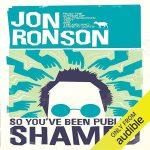
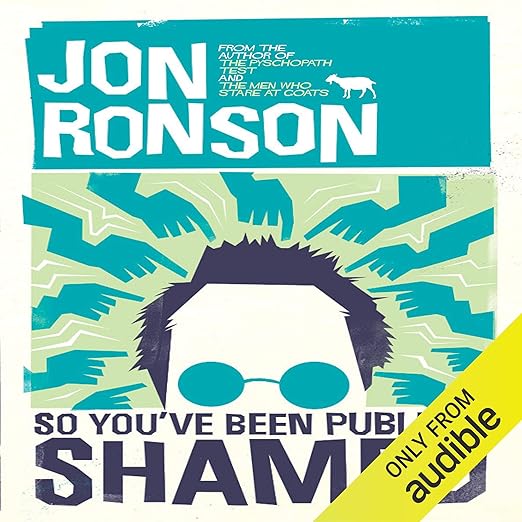
‘The terror of being found out.’ That phrase sits at the heart of Jon Ronson’s So You’ve Been Publicly Shamed, and years of scrolling have only sharpened its edge. This is a book about what happens when ordinary people, a bad joke here, a workplace mistake there, are seized by the machinery of collective outrage and spun until their lives come apart. Ronson tackles an enormous subject the way he always does: by going to meet the people trapped inside it.
What elevates the book is its refusal to stand safely outside the mob. Ronson counts himself among the shamers, and the honesty of that admission gives the whole enterprise its charge. It manages to be powerful and very funny at once, a rare combination in a book that is essentially about cruelty. At a compact 8 hours and 16 minutes, read by the author himself, it belongs on the short shelf of listens I would press on every social media user I know.
About the Audiobook
For three years, Ronson travelled the world meeting recipients of high-profile public shamings. His subjects are people like us: people whose jokes came out badly online, or who made mistakes at work, and who then watched collective outrage circle with the force of a hurricane until they were jeered at, demonised and, in some cases, sacked. From these encounters he assembles a portrait of what he calls a great renaissance of public shaming, a world in which justice has been democratised, the silent majority has found its voice, and that voice is being used to ruin the lives of anyone caught outside the boundaries of normality.
The central, most uncomfortable idea is that shame has become a form of social control, administered enthusiastically by people convinced they are doing good. Ronson, the Sunday Times top ten bestselling author of The Psychopath Test and Them: Adventures with Extremists, tells these stories with his characteristic blend of anxiety, curiosity and wit, and he is unsparing about the escalating war on human flaws and the very scary part we all play in it. It is a deeply honest piece of work about modern life, and its bite has not dulled.
The Narration
Ronson reads the audiobook himself, and it is plainly the right decision. He is an award-winning writer and documentary maker, and the book is built from encounters in which he is participant as much as observer; hearing it in his own voice preserves the nervous energy, the comic timing and the moral discomfort that live between the lines. Nobody else could deliver his double-edged questions, or his winces, quite the same way.
The delivery is distinctive, quick, anxious and dry, and it fits the subject perfectly, because this is a book narrated from inside the very worry it describes. At 8 hours and 16 minutes it is a compact listen by modern standards, easily despatched across a few commutes, and the momentum of the case studies makes it genuinely difficult to switch off. If anything, the brevity concentrates the effect; there is no padding to soften the discomfort, and the pacing never lets you settle into comfortable distance.
What Readers Say
The rating pool is small, six ratings averaging 4.4 stars, but the written responses are unusually thoughtful. One listener called the writing brilliant and the subject fascinating, noting that the project grew out of Ronson’s own time on social media, where he had witnessed, and on occasion joined, the public humiliation of people judged to have crossed societal boundaries, with cases stretching to a professional journalist who plagiarised and fabricated material. A four-star response framed the book as a set of cautionary tales likely to make anyone pause before firing off a glib, half-baked post, observing that the transgressions involved run from minor failures of taste and judgement to outright criminal acts, tied together by the shaming itself and by how each person tried to carry on afterwards.
A long-standing admirer of Ronson’s earlier work, naming The Psychopath Test among personal favourites, praised his audacity and his cheerful disregard for his own comfort and safety, paired with real honesty and no inflated sense of himself, and noted that the whole enterprise began when someone stole his identity on social media. Six ratings make a small sample, so treat the average as directional; the direction, though, is entirely clear.
Who Should Listen?
If you hold a social media account, this is for you, and that is a fair summary of the book’s reach rather than a rhetorical flourish. It belongs in the ears of anyone who has ever joined a pile-on, watched one gather speed, or quietly worried about saying the wrong thing in public. Fans of Ronson’s earlier investigations will find the same immersive, self-implicating method applied to a subject that touches everyone, and listeners who like their nonfiction both funny and morally serious will be exactly at home. It also makes a sharp companion for anyone working in media, communications or online communities, where the mechanics of outrage are a daily occupational hazard.
Before you next hit post, listen to So You’ve Been Publicly Shamed free with an Audible trial and hear what happens when the crowd turns.