Clara’s Verdict
Actors writing novels is a category that invites suspicion, and I approached Russell Tovey’s debut with every editorial defence in place. They came down inside twenty minutes. Starlings is a serious book about shame, family and reinvention, and the audio production built around it is an unusually ambitious piece of Audible Original work.
Donald is in his forties, an aspiring drag queen with, in the publisher’s phrase, a lifetime of bitterness hiding behind his nail polish. He has not been back to his northern home town since his father threw him out after catching him in his dead mother’s clothes. Then his younger brother Owen arrives on his doorstep, and the novel becomes a question rather than a plot: will Owen’s presence pull Donald out of his depression, or will Donald drag his little brother down with him?
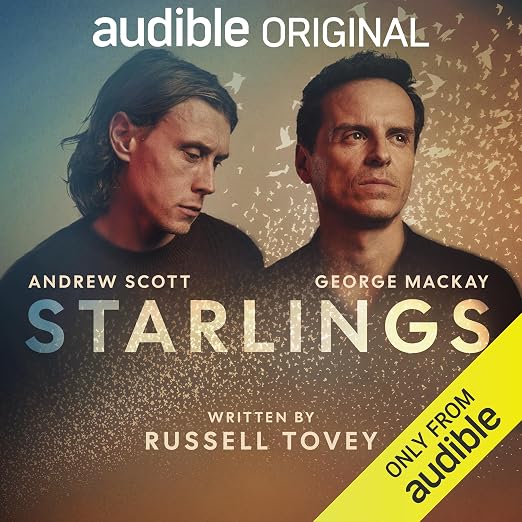
Andrew Scott plays Donald. George MacKay plays Owen. That is a formidable pairing, the recording is available in Dolby Atmos, and it is holding a place in the current Audible UK charts. The few people who have posted a rating have been unreserved about it, though the pool is far too small to lean on.
About the Audiobook
The exile at the centre of this book is specific rather than general, and Tovey is careful about the detail. Donald was not thrown out for being gay in the abstract. He was ejected for being caught in the clothes his dead mother had left behind, which folds grief, gender expression and a father’s rage into a single unbearable moment. Everything Donald has built in the years since, including the drag, sits on top of that.
Owen is described as strange and beautiful, and the ambiguity in those two words is doing real work. He is not simply a redemptive younger sibling arriving to save his brother. The novel stays honest about the possibility that proximity to Donald is dangerous for him, and about the fact that a man in a depressive spiral does not become well merely because somebody he loves needs him to be.
Around the two brothers the production assembles a company: Jason Patel, Julian Kostov, Michele Austin, and Tovey himself. That last credit is worth a moment. An author appearing in his own multi-cast adaptation could easily be vanity, but on this material it reads more like proximity, a first time novelist wanting to be in the room where his book is made audible.
Eight hours and four minutes is well-judged. Long enough for the brothers’ history to accumulate weight, short enough that the depressive register never becomes an endurance test, which is a genuine risk with this kind of interior novel.
The Narration
Andrew Scott is the reason this production exists in the form it does. He specialises in exactly the register the part needs, which is a man who is extremely funny on the surface and in serious trouble underneath, and who uses the first to stop anybody examining the second. Donald’s bitterness is his armour, and armour is easy to play as simple nastiness. Scott plays it as effort, which is a far more painful and far more accurate choice.
George MacKay is the quieter half of the pairing and has the harder assignment. Owen must be genuinely odd without becoming a device, present enough to change his brother’s life and passive enough that Donald’s response to him remains the story. MacKay has a naturally unforced delivery that suits somebody whose strangeness is not performed, and the contrast with Scott’s more worked, more defended voice is the production’s central effect.
Dolby Atmos is not a detail I would usually dwell on, but for a novel moving between a northern town, a flat and a stage in a bar, a spatial mix has real work to do. It changes the apparent size of rooms, and a book about a man who feels too large for his origins and too small for his ambitions benefits enormously from rooms that have size.
What Readers Say
Very few people have rated this yet, so I would not put weight on the average. The written responses, though, are among the most emotionally direct I have read for anything in the current charts, and they agree closely about what the book does.
“About family (chosen or bio) and how we build and rebuild lives with each other.”
That reviewer, posting as sugoi-ne, headed their piece “Feel seen”, called the characters “gorgeously brought to life”, and stated the book’s argument plainly: “How queer spaces and communities save us.” They also allow that they may have cried a bit. I mention that not for colour but because it locates the book accurately. This is not a comic novel about drag with a sad passage in the middle. It is a book about being disowned, written by somebody who takes that seriously.
The second review is shorter and makes the audio point explicitly. C. Durey calls it raw and relatable, praises it as well written and performed, and describes it as a joy to listen to. The distinction between written and performed matters there, because it is one of the few pieces of listener feedback in this part of the charts that separates the book from the production and approves of both.
Who Should Listen?
I would press this on anyone who has had to build a family out of people they were not born to, and on anyone who has watched a sibling try to rescue somebody who did not want rescuing. It is also, straightforwardly, a showcase for two very fine actors, and if you follow Andrew Scott’s work at all it is essential.
Be warned that it goes to some dark places. Parental rejection, depression and the long consequences of losing your home to a parent’s disgust are the substance of the book rather than its background, and it does not resolve them tidily. If you want drag treated as pure joy, this will not give you that, since the joy here is hard won and arrives late. What you get instead is a debut novelist with something specific to say and a cast good enough to say it for him.