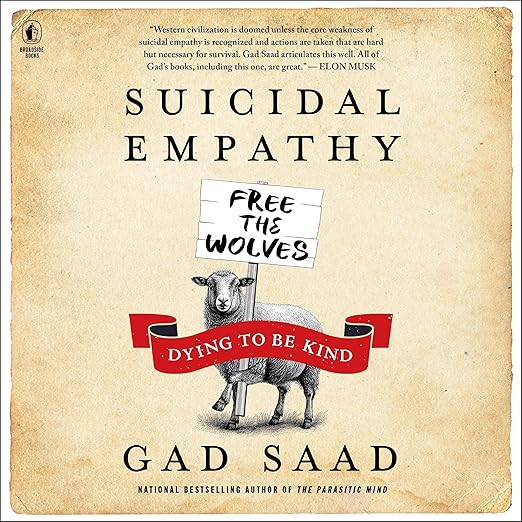
Clara’s Verdict
I am going to be straightforward about what Suicidal Empathy is before saying anything about what it does. This is a polemical work from the right of the political spectrum, published by Broadside Books – a conservative imprint of HarperCollins – and written by Gad Saad, a Lebanese-Canadian evolutionary psychologist who has built a substantial public platform arguing against what he characterises as progressive cultural excess. The framing of the book – “suicidal empathy,” “civilisational collapse,” “inverse morality” – is deliberately maximalist. It is designed to provoke recognition in sympathetic readers and outrage in hostile ones.
That is not a reason not to review it. It is a reason to be precise about what kind of listener this is for, what they are getting, and what intellectual caveats are worth carrying in.
About the Audiobook
Forthcoming from Broadside Books in May 2026, Suicidal Empathy is Saad’s follow-up to The Parasitic Mind (2020), which established the central metaphor he returns to here: that certain ideas function as parasites on the mind’s rational faculties, producing behaviours that serve the idea’s propagation rather than the host’s flourishing. The new book applies this framework specifically to empathy as a political and moral category, arguing that Western societies have so miscalibrated their empathic responses that they now systematically prioritise the wrong actors in every moral equation – criminals over victims, non-citizens over citizens, feelings over evidence.
The argumentation is accumulative and rhetorical rather than analytically sequential. Saad marshals a series of specific policy positions and social phenomena – treatment of violent offenders, immigration practice, transgender inclusion in competitive sport, the tolerance of public drug use – as evidence for a broad civilisational thesis. Each example is offered as further proof of the same underlying diagnosis rather than as an independently established causal claim. Readers who prefer their arguments structured as formal evidence chains will find the methodology frustrating; readers who find the diagnosis intuitively correct will find the accumulation satisfying.
There are no Audible reviews at time of writing. This is a pre-publication entry for a May 2026 release, and the audience will arrive with strong prior views in either direction.
It is worth contextualising Broadside Books as an imprint for readers unfamiliar with it: Broadside publishes explicitly conservative political and cultural commentary, and its catalogue includes authors from the broader American right-wing media ecosystem. This context does not determine the quality of the arguments made in any given book, but it does clarify the intellectual community the work is in dialogue with and the premises it does not question. Saad’s previous book The Parasitic Mind was praised by figures including Jordan Peterson and Steven Pinker, and criticised by academics who found its use of evolutionary psychology to explain contemporary political phenomena methodologically stretched. Readers interested in that critical conversation would do well to approach this book with awareness of where it sits in that ongoing debate.
The evolutionary psychology framework Saad deploys – the idea that modern progressive politics represents a hijacking of adaptive empathic mechanisms by maladaptive social pressures – is presented as self-evident rather than as a hypothesis requiring evidential support. Listeners coming from academic backgrounds in evolutionary biology, psychology, or political science will find the argumentation less rigorous than its scientific framing implies. This is worth noting not as a reason to dismiss the book but as a reason to read it as political commentary in a scientific register rather than as peer-reviewed science in political clothing. The distinction matters for how you assess the claims.
The Narration
Saad narrates his own work, which is consistent with his broader approach to public communication. His platform has been built substantially on direct address – through his Gadfather podcast and his previous books – and his narration carries the cadence of someone who has been making these arguments in public for years. The delivery is engaged, frequently sardonic, and comfortable with the rhetorical territory it occupies. For listeners already familiar with his mode of speech, this will feel like an extended version of his public output. For those coming to him fresh, the rhetorical temperature may require some adjustment.
What Readers Say
No reviews are available at time of writing for this Audible release. Saad’s previous work The Parasitic Mind attracted strongly polarised responses across platforms, which is the reasonable expectation here. Listeners should be aware that the argumentation is polemical in method and that several specific empirical claims in the broader genre of cultural commentary – particularly those drawing on evolutionary psychology to explain contemporary political phenomena – have been contested by researchers working from different methodological frameworks. This is worth noting not to dismiss the book but to contextualise the kind of engagement it rewards.
Who Should Listen?
Readers already engaged with Saad’s previous work or with the broader tradition of conservative cultural commentary he operates within. Those approaching from different political positions who want to understand the argument being made will find it clearly and energetically stated, even if the framing is maximalist. This is not a book designed to persuade the uncommitted – it is written for an audience that already finds its premises plausible. Those who found The Parasitic Mind compelling will find this a direct and substantively developed continuation of that project.