Clara’s Verdict
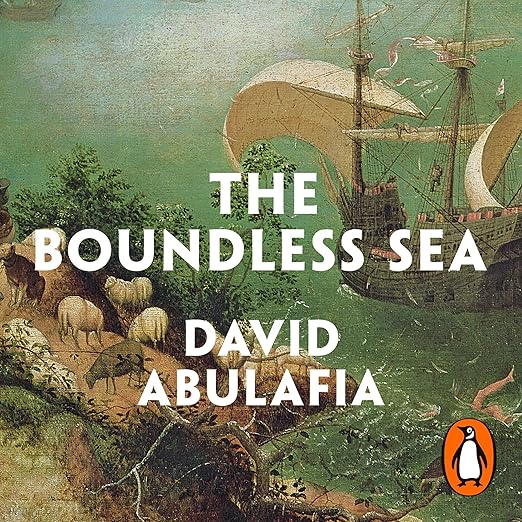
David Abulafia won the Wolfson History Prize in 2020 for The Boundless Sea, which is the most prestigious award in British historical writing, and the recognition is entirely deserved. This is history on an extraordinary scale – a complete account of humanity’s relationship with the oceans from the first Pacific voyagers to the supertanker routes of the present day – written with the narrative confidence of a novelist and the scholarship of a historian who has spent decades thinking about little else. Jonathan Keeble’s narration of this forty-one-hour audiobook is a formidable performance. The 4.5 rating from 535 listeners is not a small-sample enthusiasm but a reliable indication of a work that has found and sustained a substantial audience. For anyone interested in how the world became connected, this is the book.
About the Audiobook
Abulafia begins where the evidence begins: with the Polynesian navigators of the Pacific, who were making extraordinary open-ocean voyages by the first century of the common era, finding their way between islands scattered across an ocean that covers a third of the planet using techniques – star paths, wave patterns, bird flight, cloud formation – that modern navigators are still working to fully understand. From there, the book traces the emergence of the Indian Ocean trade networks, the spice routes that connected Arabia to southern China and Japan, the Atlantic ventures of the Vikings and Bretons long before the Portuguese began their famous explorations, and the successive maritime empires of Portugal, Spain, the Netherlands, and Britain.
What Abulafia brings to this material is a refusal to tell it as the story of European expansion with other cultures as background or prelude. The Polynesians are not a prologue to Columbus. The Arab and Indian Ocean trading networks are not context for Vasco da Gama. Each maritime culture gets its own analytical attention on its own terms, which transforms a global history that could easily be a colonial history into something genuinely global in its sympathies and methods.
The breadth is staggering, but the depth at any given point is maintained by Abulafia’s ability to anchor macro-historical arguments in specific human stories – the merchants, pirates, cartographers, and explorers whose individual decisions accumulated into the connected world we inhabit. His account of the medieval spice trade, of the Danish East India Company, of the role of the Åland Islanders in nineteenth-century grain shipping, covers material that standard maritime histories simply omit. That commitment to the less-examined corners of the story is one of the book’s greatest pleasures.
The fact that ninety per cent of global trade still moves by sea gives all of this a contemporary urgency that Abulafia does not overplay but does not ignore. This is not antiquarian history. It is the story of the infrastructure on which the present world depends.
The Narration
Jonathan Keeble reading forty-one hours of dense historical scholarship is a considerable achievement in sustained concentration and craft. His voice carries the kind of measured authority that makes complex chronology comprehensible without becoming monotonous – he understands that history of this ambition requires a narrator who can modulate pace and tone across an enormous range of material, from the navigational techniques of Pacific islanders to the financial mechanics of the Dutch East India Company. The difference between a chapter on Polynesian wayfinding and one on British colonial trade is significant, and Keeble respects those differences. For a book of this length, you need to genuinely enjoy the narrator’s company. Keeble is very good company across forty-one hours.
What Readers Say
The Boundless Sea holds a 4.5 out of 5 from 535 listeners, making it one of the most substantially reviewed serious non-fiction audiobooks in this category. One listener called it “one of the greatest histories ever written” and their desert island choice, noting they felt genuine bereavement on finishing and immediately ordered Abulafia’s book on the Mediterranean. Another noted the scholarship as vast but accessible, describing each chapter as a self-contained adventure. Reviewers praised the coverage of obscure maritime history – the Danish East India Company, the Åland Islanders, the role of Breton sailors in Atlantic exploration – as genuinely surprising and valuable. A measured critical voice acknowledged the book as well-researched while noting that voyages of scientific discovery receive less attention than trading routes, which is an accurate characterisation of the book’s priorities rather than a failing.
Who Should Listen?
For anyone with an interest in global history, maritime history, or the long story of how human beings have moved across and connected the planet. At forty-one hours, this is a serious commitment – the equivalent of a full working week’s continuous listening – but the payoff is proportionate. One reviewer wisely noted it is probably not a quick read on the beach, but then the best history rarely is. This is the kind of audiobook that changes the way you see the world, permanently and for the better.
Find The Boundless Sea on Audible UK, or via Kobo, Scribd, and Storytel.