Clara’s Verdict
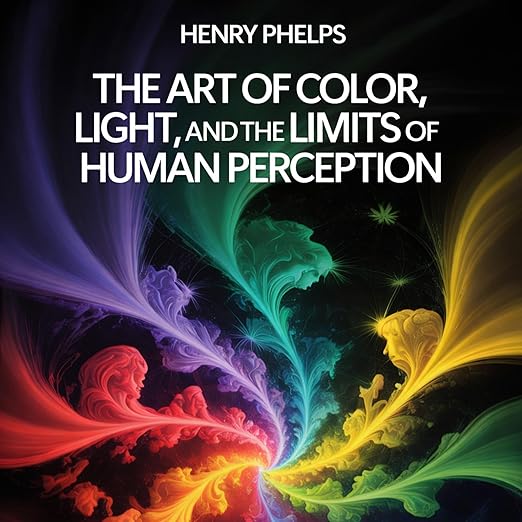
There is a particular kind of audiobook that sets out to change the way you look at the world – quite literally. The Art of Color, Light, and the Limits of Human Perception by Henry Phelps is one of them. Narrated with quiet authority by Rush Stone, this is a meditation on the invisible machinery of seeing: why the crimson of a Tudor tapestry moves us differently from the blood-orange of a setting sun, and why our brains are, in the most wonderful sense, unreliable witnesses to the spectrum.
I picked this up expecting an illustrated lecture in audio form. What I got was something closer to a guided reverie – art history, perceptual psychology, and a dash of philosophy braided together with enough rigour to satisfy the curious, and enough warmth to hold even the most science-averse listener. It won’t be the final word on colour theory, but as an introduction that refuses to be dull, it earns its place.
About the Audiobook
Henry Phelps positions himself as both artist and curious thinker, and the book moves accordingly: from the science of wavelengths and cone cells to the cultural histories of pigments, from Vermeer’s costly lapis lazuli to the neon palette of the digital age. The central argument is that what we call “seeing” is really an elaborate act of interpretation – one shaped by evolution, culture, memory, and the peculiarities of individual perception.
The chapters on art history are particularly strong. Phelps traces how painters from the Renaissance onward have weaponised light and colour to control emotional response – how Caravaggio’s chiaroscuro creates moral drama, or how the Impressionists essentially painted not things but the light falling upon them. The science sections explain phenomena such as simultaneous contrast and the opponent-process theory in plain language, though listeners with a background in visual arts or neuroscience will find the depth a little modest.
At just under five hours, this is a lean listen – more primer than treatise, but polished and purposeful.
The Narration
Rush Stone delivers a performance that suits the material beautifully. His voice is measured and warm without being soporific – a real skill when discussing topics that risk becoming either too academic or too poetic. Stone handles the pivot between scientific explanation and aesthetic reverie with ease, giving each mode its own texture without losing the thread of the argument. The pacing feels considered; there is space to think without the narrative ever stalling. For a first-time production from an independent publisher, the audio quality is commendably clean.
What Readers Say
This title is newly released and has not yet accumulated listener reviews – which is not unusual for a niche non-fiction audiobook from an independent publisher. That said, early interest from listeners in the arts and sciences communities suggests it has found its audience. If you enjoy books that shift the way you experience everyday phenomena, this one is worth your time before the critical consensus catches up.
Who Should Listen?
Artists, designers, and photographers who want to understand the science underpinning their intuitions will find this rewarding. So will neuroscience enthusiasts, art history lovers, and anyone who has ever stood in a gallery wondering why a particular painting refuses to release them. It works especially well on headphones during a walk – the world outside becomes a rather good companion to the ideas being discussed inside.
At under five hours, the commitment is modest and the potential pay-off – genuinely altered perception – rather large. Listen to The Art of Color, Light, and the Limits of Human Perception on Audible UK and see what you’ve been missing.