Clara’s Verdict
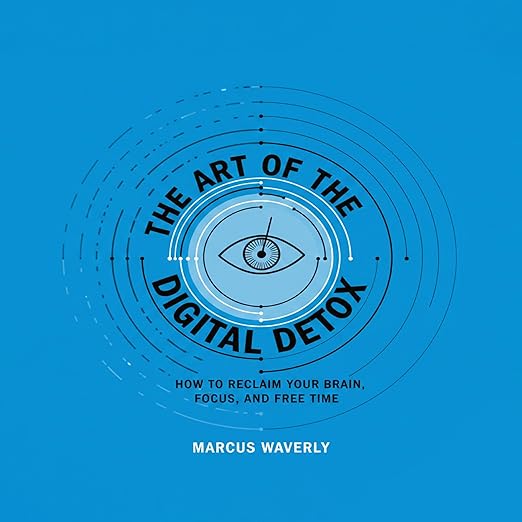
I downloaded this one on a Tuesday morning, sitting at my desk with three browser tabs open, a podcast half-playing in the background, and my phone face-up to my left like a territorial little beast. I am not, it turns out, the ideal candidate for digital wellness. I am the problem. And Marcus Waverly, to his credit, opens The Art of the Digital Detox by addressing exactly that kind of person – not the already-converted minimalist, but the person who knows something is wrong and keeps refreshing anyway.
At just over an hour, this is a short listen, and that brevity is itself a statement of intent. Waverly is not here to fill your queue with filler. The argument is clear and efficiently made: you do not need more willpower, you need a better system. It is a reframe that actually lands, and one that distinguishes this title from the more evangelical end of the digital wellness genre.
About the Audiobook
The core premise of The Art of the Digital Detox is that our phones and screens are not neutral tools that we have failed to manage correctly – they are deliberately engineered to capture and hold attention, and any strategy that relies solely on personal discipline is fighting an asymmetric war. Waverly draws on what is now a fairly well-established body of research around dopamine loops, notification design, and the ways social media exploits our social-comparison instincts.
What separates this from the more alarmist strand of the genre is the pragmatism. There is no call to smash your devices or retreat to a remote cabin. Instead, Waverly guides listeners through a process of habit redesign: how to structure your environment so that reaching for your phone is not the path of least resistance, how to build boundaries that work at a household level rather than just an individual one, and how to rebuild an attention span that modern digital life has quietly eroded.
The book also addresses the family dimension with some care, which feels genuinely useful for parents navigating screen time with children. Published in March 2026, it reflects a cultural moment in which the backlash against compulsive tech use has moved well beyond niche wellness circles and into mainstream conversation.
The Narration
Elizabeth Stockton reads with a calm, measured authority that suits the material well. There is no breathless urgency here, which is exactly right for a book that is, at its heart, asking you to slow down. Her pacing allows the practical strategies to land rather than blur past, and she handles the more technical passages around neuroscience and habit formation without making them feel like a lecture. For a self-help audiobook, the narration is genuinely pleasant company.
What Readers Say
This title was released in late March 2026 and does not yet carry a public rating on Audible UK. That is worth noting – not as a strike against it, but as an honest caveat. The audiobook is very new, and reader opinion has not yet accumulated. Based on the content and production quality, however, it sits well within a genre that has a strong listener base in the UK. Titles addressing digital overload have performed consistently well, particularly among listeners aged 30 to 50 who recognise the problem but have struggled to act on it.
Who Should Listen?
This is a strong choice for anyone who has already read the headlines about smartphone addiction and found the knowledge insufficient to change their behaviour. It is particularly well-suited to parents trying to model better habits, professionals whose working day has become a blur of notifications, and anyone who has gone to bed intending to read a book and found themselves scrolling instead. At just over an hour, it is not a burden on your schedule – which is rather the point. Listen on Audible UK