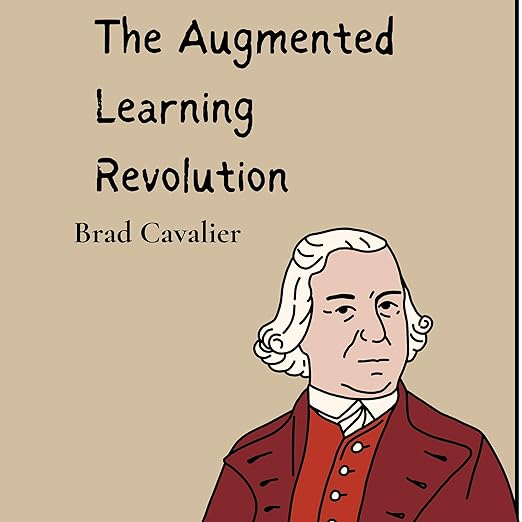
Clara’s Verdict
Education technology books have a shelf-life problem. By the time they are written, edited, produced, and published, the technology they describe has moved on, and the frameworks built around it can start to feel like furniture arranged around a door that no longer opens the same way. The Augmented Learning Revolution by Brad Cavalier is aware of this risk, perhaps a little too aware of it, and hedges accordingly. The result is a book that functions well as a conceptual orientation but is somewhat cautious about the specifics that would make it genuinely useful to practitioners right now.
At just over an hour, this is a primer rather than a programme. That is not a criticism. It is a categorisation. Cavalier is offering orientation rather than implementation, and judged on those terms, it does the job adequately. The core argument that augmented reality transforms passive reception of information into active, embodied engagement with it is durable enough to outlast the specific platforms and products currently available, and it is that conceptual contribution that will retain value as the technology landscape continues to shift.
The honest assessment is that this book is best understood as vocabulary-building: it gives educators, administrators, and technology professionals the language to participate in conversations about AR in education that they might otherwise find opaque. That vocabulary function is where short-form technology surveys consistently earn their keep, even when they cannot deliver the depth that specialists require.
About the Audiobook
Published in March 2026 by Brad Cavalier, The Augmented Learning Revolution sets out to explain how augmented reality is reshaping educational practice across K-12 schools, higher education institutions, and professional training environments. The book covers student engagement, immersive learning design, the use of 3D visualisation and digital overlays, and the broader question of how AR bridges the gap between theoretical knowledge and applied experience.
There is a useful section on inclusive education, exploring how AR can be deployed to reach learners who struggle with traditional instructional formats, and the book’s treatment of lifelong learning environments is genuinely forward-thinking. Cavalier is not just writing about classrooms. He is writing about any context in which knowledge needs to be transmitted, retained, and applied, from corporate training programmes to professional certification environments to informal self-directed study.
The book also addresses the question of return on investment for AR in educational settings, which is the question most administrators will have before any other. Cavalier is honest about the limitations of current measurement frameworks: the evidence base for AR-specific outcomes is still developing, and the book acknowledges this rather than overstating the case. That honesty is one of the things that distinguishes it from more enthusiastic EdTech advocacy that treats preliminary results as established fact.
The sections on practical implementation are necessarily at a high level given the format, but they are structured in a way that gives educators and institution leaders a useful vocabulary for evaluating AR proposals and planning pilot programmes. The case studies are illustrative rather than deeply analytical, but they serve their purpose as concrete anchors for the broader conceptual arguments.
Future trends receive their own section, and while specific forecasts in technology books age poorly, the broader directions Cavalier identifies, personalised learning, immersive simulation, and the blurring of physical and digital learning environments, are well-supported enough to function as reasonable planning assumptions regardless of which specific technologies deliver them over the next decade.
The Narration
Myriam Berger’s narration is clean and professional: a clear, mid-paced delivery that suits educational and explanatory content well. She does not add much interpretive colour, but then the material does not call for it. This is a survey text rather than a narrative, and clarity of delivery is the primary virtue required. For seventy-four minutes of concept-led content, Berger keeps things moving without making them feel rushed, and her handling of technical terminology is confident throughout.
What Readers Say
The Audible listing for this title returned an unusual rating notice rather than a numeric score, suggesting the data is either still loading or caught in a cataloguing anomaly. As of early 2026, no substantive reader feedback is available. Given the book’s target audience of educators, EdTech professionals, and policymakers, it is likely to find its readership through professional networks rather than Audible’s general recommendation engine, and reviews may accumulate slowly as the book finds its specialist audience.
Who Should Listen?
This works best as background reading for educators or training professionals who want a conceptual map of where AR fits into modern pedagogy, rather than step-by-step implementation guidance. It is a sensible listen for anyone preparing a presentation, building a case for AR investment in their institution, or wanting to understand what the conversation is about before engaging with more specialised material. At just over an hour, it earns its keep on a commute. Those seeking hands-on technical guidance or detailed case study analysis will need to look elsewhere. Listen on Audible UK