Clara’s Verdict
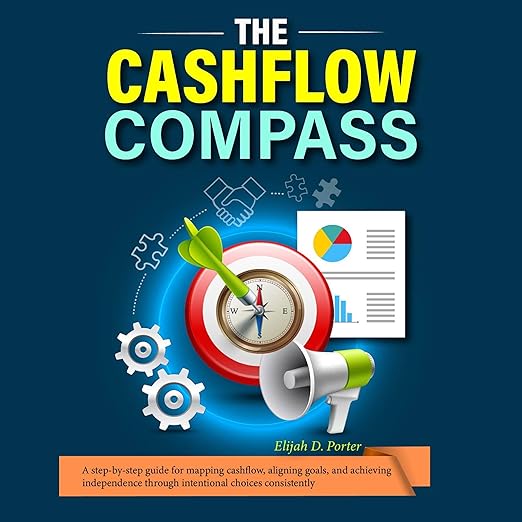
Personal finance audiobooks occupy a peculiar corner of the publishing world. The good ones are rarer than the genre’s popularity would suggest, because the challenge is not conveying the information, which is broadly consistent across reputable titles, but reframing it in a way that changes how the listener thinks rather than merely what they know. The Cashflow Compass, by Elijah D. Porter, earns its place in the better half of the genre by making that distinction its central project.
Porter’s key move is framing wealth not as something that happens to fortunate people, nor as something that can be seized through aggressive optimisation, but as something that is engineered through deliberate decisions taken consistently over time. That reframing is not entirely new, but Porter applies it with enough specificity and practical structure that it feels grounded rather than motivational in the hollow sense. He is more interested in changing your system than in changing your mindset, which is the right instinct for a book of this kind.
About the Audiobook
Running for 3 hours and 43 minutes and published in February 2026, The Cashflow Compass organises its argument around a central idea: that most people think about money primarily in terms of income and spending, but that real financial progress requires mapping the full journey of money through your life, including how it moves into and out of savings, investments, and debt. The framework Porter provides for visualising this flow is the backbone of the book, and it gives the more tactical advice that follows a coherent context rather than leaving individual techniques floating without structural justification.
The book covers emergency reserves, strategic debt evaluation, the case for automating financial decisions to reduce emotional interference, and portfolio allocation without overreacting to market noise. The last of these is among the most practically important sections, and Porter handles it with admirable restraint; he is not promising outsized returns or endorsing any particular investment strategy, but rather building the case for consistency and structure over speculation and headline-driven reaction. In a financial environment that generates anxiety more reliably than it generates clarity, that measured approach is valuable.
Porter is also careful about what the book is not. It does not promise a path to financial independence in five years, and it does not dress up aspiration as analysis. There is an honesty in the framing that distinguishes it from the more evangelistic end of the personal finance genre, where transformation is always just around the corner and the reader is always one mindset shift away from abundance. Porter is writing for people who live in the real world, where progress is incremental and the variables are not always under your control.
The inclusion of checklists, decision rules, and planning templates is mentioned in the synopsis. In audio format, these work best as companion materials rather than integrated listening, and listeners will benefit from pausing to implement the frameworks rather than treating the book as purely passive consumption. At under four hours, the book is digestible in a single long session or across two commutes, and the pacing reflects that: dense enough to be substantive, but not so compressed that the listener cannot absorb the frameworks being introduced. The examples drawn from financial planning, behavioural psychology, and real-world case studies ground the abstract principles in recognisable situations.
The Narration
Eddie Leonard Jr. brings a reliable professional presence to the narration. He is a narrator with a strong track record in nonfiction, and his delivery here suits the book’s combination of structured argument and practical instruction. The voice is assured without being authoritative in a way that alienates, and Leonard Jr. gives the behavioural psychology sections, where Porter draws on research into financial anxiety and decision-making under pressure, the right emotional weight without tipping into drama. For a title where credibility is everything, the narration serves the content well and makes the 3-hour 43-minute runtime easy to sustain.
What Readers Say
No Audible ratings have been recorded for The Cashflow Compass at the time of writing. Published in February 2026 through an independent publisher, it is an early-stage title that has not yet accumulated listener reviews. The recommendation here rests on the content and its structure rather than on accumulated listener consensus. For practical financial guidance in the under-four-hour category, the framework Porter outlines is coherent, the approach is level-headed, and the absence of hype or extreme claims about financial transformation is itself a mark in the book’s favour.
Who Should Listen?
The Cashflow Compass suits listeners who feel financially stretched or directionless and want a structured framework for thinking about money rather than another round of motivational platitudes or extreme savings challenges. It works equally for those starting their financial journey and those rebuilding after setbacks, because the cashflow mapping framework is designed to function at any income level and any starting point. If you have already read extensively in the personal finance space and have a working system, much of this will feel familiar. For everyone else, under four hours is a modest investment for the kind of systematic clarity this book offers.