Clara’s Verdict
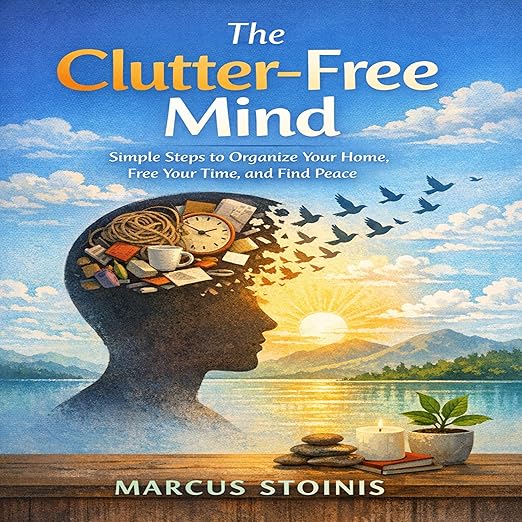
I have a complicated relationship with decluttering literature. After a decade in publishing, where offices accumulate paper with the urgency of geological sediment, I understand the appeal of systems that promise order. But I have also reviewed enough self-help audiobooks to know the difference between a book that offers a genuine framework and one that dresses common sense in the language of revelation. The Clutter-Free Mind, by Marcus Stoinis, narrated by S.L. Powell, and published in March 2026, sits closer to the former than you might expect from a 1 hour and 19 minute overview with no established rating.
The book is honest about what it is not trying to do: this is not a manifesto for minimalism, and it does not promise a monastic existence at the end of the process. The framing is practical and self-aware. The specific focus on the psychological dimensions of clutter, the stress, the decision fatigue, the emotional attachment to objects, gives it more substance than the usual room-by-room decluttering manual. Stoinis treats the mental dimension of physical disorder seriously, which is where most of the interesting thinking in this genre actually lives.
About the Audiobook
The structure moves from the psychological to the practical in a sensible sequence. Stoinis opens by framing clutter as a stress problem rather than merely a storage problem, which is a useful reframe that most listeners will recognise from their own experience. The subsequent chapters address wardrobe organisation, paper and digital chaos, kitchen efficiency, shared spaces, and bedroom sanctuary creation, the usual geography of home organisation books, but with a consistent emphasis on emotional rather than purely logistical obstacles.
The most useful practical tools offered are the One-In, One-Out rule for preventing clutter from returning once cleared, and the 10-minute Daily Evening Sweep as a maintenance habit. Both are simple enough to be actionable and specific enough to be meaningful, which is the right combination for audio content that listeners cannot easily refer back to without replaying. The runtime of 1 hour and 19 minutes makes this a lunch-hour listen rather than a weekend project. Published by ADRIAN ANDY PALMER in March 2026, it is a self-published title without an established Audible rating, which means prospective listeners are essentially making a judgement on the content description rather than a community consensus.
The explicit rejection of minimalism as an endpoint will appeal to listeners who have felt alienated by the more evangelical end of the decluttering movement. Stoinis is not asking you to own fewer things because fewer things is inherently virtuous. He is asking you to remove the things that are actively creating friction in your daily life, which is a different and considerably more practical proposition.
The Narration
S.L. Powell delivers the material cleanly and without affectation. For practical self-help content at this length, the narration needs to be clear and encouraging without tipping into the motivational-speaker register that can make this genre feel exhausting. Powell avoids that trap consistently. The pacing is appropriate for content that listeners may want to absorb and apply rather than simply consume, and the tone is warm without being saccharine. This is a competent, unshowy performance that serves the material well and does not call attention to itself when the listener should be thinking about what they are hearing rather than how it is being delivered.
What Readers Say
No listener reviews are available on Audible UK at the time of writing. As a self-published title from a small publisher with a very short runtime, this is an understandable starting position. Prospective listeners should sample before purchasing to assess whether the approach and tone match their expectations. The content as described is accurate to the genre, and the practical tools are straightforward enough to be genuinely useful. The proof of any decluttering guide lies in whether the listener actually clears a drawer as a result, and that is a test no review can run in advance on anyone else’s behalf.
Who Should Listen?
Well-suited to listeners who already know they need to address physical clutter but who have resisted more demanding or more ideologically committed approaches to home organisation. The explicit rejection of minimalism as an endpoint will appeal to people who want a functional home rather than a spare one. At under 80 minutes, this is a reasonable starting point for listeners who have never engaged with the decluttering genre and want to understand the principles before committing to a longer, more detailed guide. Also works as a refresher for listeners who have engaged with the genre before and want a concise reminder of the core principles without revisiting a longer work. Approach as orientation rather than comprehensive instruction.