Clara’s Verdict
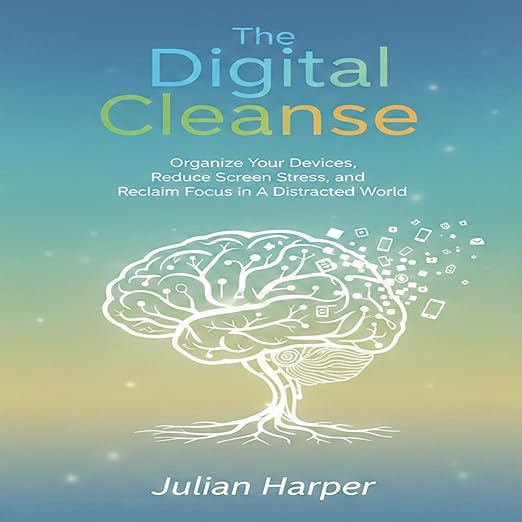
I picked this one up on a Tuesday evening after spending the better part of the day fighting my own inbox – 2,300 unread emails, a phone that hadn’t stopped buzzing since breakfast, and the vague, low-grade anxiety that seems to follow me everywhere screens go. The Digital Cleanse by Julian Harper arrived at exactly the right moment, and at just over an hour, it asks very little of you in return for what it offers: a practical reset for your relationship with technology.
Harper’s central argument is a sensible one, and refreshingly sane. He is not asking you to throw your phone into the Thames or spend a fortnight in a woodland cabin. He is asking you to do something far harder: to look honestly at what your digital habits are costing you, and to make deliberate, sustainable changes. Narrated by Gordon Webster in under 75 minutes, this is the kind of audiobook you could listen to during a single commute and come away with a handful of things you actually intend to do. Whether you follow through is, of course, another matter entirely.
About the Audiobook
Published in March 2026 by JOE ZACHARY COLLINS, The Digital Cleanse is a short, tightly structured personal development title that tackles digital overload with pragmatic common sense rather than evangelical fervour. The book is built around a recurring frustration many of us share: technology promised to make our lives easier, and instead delivered an endless queue of obligations – unread emails in the thousands, notifications that interrupt every train of thought, photo libraries that have become archaeological digs rather than memories.
What distinguishes this title from the broader digital wellness genre is its explicit rejection of extremism. Harper is careful not to position himself as a minimalist evangelist. The goal is not to use less technology but to use it better – to stop being managed by your devices and start managing them. The book covers practical territory: clearing email backlogs without stress, disabling notifications selectively, organising files so that retrieval takes seconds rather than minutes, and setting workable limits on social media use. There is a recurring framework built around a 15-minutes-per-week maintenance habit, which is appealingly realistic.
The runtime of one hour and ten minutes means the coverage is necessarily broad rather than deep. This is a primer, not a comprehensive manual, and it works best if you treat it as a catalyst rather than an instruction booklet. Those hoping for nuanced psychological analysis of digital addiction or evidence-based research into attention will need to look elsewhere. What you get here is a sensible set of principles delivered clearly and without fuss.
One aspect Harper addresses that distinguishes this title from purely reactive guides is environmental design: rather than relying on willpower to resist checking your phone, he argues for restructuring your physical and digital environment so that resistance becomes the default. It is a small but genuinely useful reframe, and one of the more memorable ideas in a short book full of practical principles.
The Narration
Gordon Webster brings a measured, unhurried quality to the reading that suits the material well. His voice is warm but not performative – the kind of tone you might associate with a knowledgeable colleague who has thought carefully about what he is going to say before saying it. For a book that is fundamentally about slowing down and paying attention, the pacing feels considered rather than rushed. There are no histrionics, no sales-pitch energy – just clear, calm delivery of practical advice. Webster does not have a great deal of dramatic material to work with in a book of this nature, and he does not try to manufacture any. A decent performance for the genre.
What Readers Say
This title was released in March 2026 and, at the time of writing, has not yet accumulated Audible ratings or reviews. Given the very short runtime and the self-published nature of the title, it is likely to attract listeners who are already receptive to the subject matter rather than seeking entertainment. The absence of reviews is worth noting – it is not a signal of poor quality so much as the reality of a recently released, niche instructional title.
Who Should Listen?
If you are someone who ends most evenings feeling vaguely overwhelmed by your own phone, or who has been meaning to sort out their inbox for the past three years without ever quite managing it, this is a low-commitment starting point. At seventy minutes, it costs you almost nothing to try. It is particularly well suited to those who want permission to make changes without being told they need to transform their entire lifestyle. It is less useful for those who have already read widely in this space – the ground Harper covers will feel familiar if you have spent time with Cal Newport’s Digital Minimalism or Jenny Odell’s How to Do Nothing. But as an entry point, it is perfectly serviceable.