Clara’s Verdict
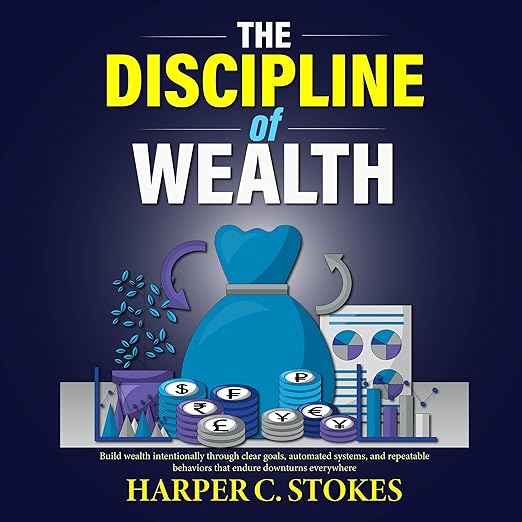
Nearly four hours of personal finance audiobook from a debut author with no public profile and a publisher name that does not correspond to a recognisable imprint. That is the starting position for The Discipline of Wealth by Harper C. Stokes, and I want to be honest about what that means for a listener assessing it cold. The personal finance category is perhaps the most flooded section of the self-help shelf, and a high proportion of what gets produced there is either reheated common sense or a vehicle for courses and coaching products. Stokes’s book is neither of those things, which is worth noting.
What it actually is, across nearly four hours, is a clear and systematically organised argument that building wealth is primarily a behavioural challenge rather than a technical one. The thesis is not original – James Clear, Morgan Housel, and Ramit Sethi have all worked this same ground – but it is developed with genuine care and a useful degree of practical specificity. This is not a transformative read, but it is a competent and honest one, and in this category that is not nothing.
About the Audiobook
The book is structured around what Stokes calls a behaviour system for money. Rather than opening with the standard dramatic personal story of financial ruin and redemption, it begins with the principle that most financial mistakes are not the result of ignorance but of friction: the gap between what you know you should do and what you actually do under conditions of fatigue, stress, or emotional volatility. The solution Stokes proposes is designing guardrails – automated systems and simple decision rules that remove the need for willpower in the moments when willpower is in short supply.
The practical material covers the fundamentals competently: emergency buffers, debt sequencing, values-driven spending plans, account architecture, and investment automation. None of this will surprise anyone who has read a handful of personal finance books. The differentiating value is in the integration – Stokes is good at showing how these elements connect to each other as a system rather than a list of unrelated tasks. The section on eliminating friction is the strongest in the book, and the frameworks for reviewing financial progress without developing an unhealthy relationship with market fluctuations are genuinely useful.
The book also has a short but substantive section on the psychological dimension of wealth-building: patience, setbacks, and the discipline to stay consistent when external conditions argue against it. This is handled without the motivational-poster quality that plagues so much of this genre, which I appreciated. The title does not try to motivate you into action through anxiety. It assumes you are already motivated, and that the problem is structural rather than attitudinal – a framing that will resonate with anyone who has spent years knowing the right answer and still not implementing it.
The book’s approach to investment is notably restrained. Stokes does not advocate for specific products, does not make predictions about markets, and does not tie the advice to any particular economic environment. The frameworks are designed to function regardless of whether interest rates are rising or falling, which gives the book a durability that more market-specific titles tend to lack within eighteen months of publication.
The Narration
Eddie Leonard Jr. narrates and does so with the kind of measured authority that this type of content needs. He is not flashy, and that is correct for the material. Personal finance audiobooks require a narrator who sounds trustworthy rather than enthusiastic, and Leonard Jr. delivers exactly that quality. The pacing is deliberate without being slow, and he handles the more technical passages – compound interest mechanics, account organisation frameworks – with enough emphasis to keep the listener tracking without turning the book into a lecture. A solid performance for a niche that rarely produces spectacular ones.
What Readers Say
No listener ratings or reviews are available at time of writing, which reflects the book’s release date of 3 February 2026. For a self-published title in a competitive category, early absence of community feedback is neither surprising nor necessarily a negative signal. The content quality stands independently of reviewer consensus, and the approach is serious enough to warrant a listen for anyone actively thinking about building more intentional financial habits.
Who Should Listen?
This works best for someone in their late twenties to forties who has moved past the basics – they know what an ISA is, they are not in crisis – but whose financial life feels more reactive than intentional. The behavioural framing is particularly useful for people who have read the advice before and still find themselves not following it. It is not the right listen for beginners who need the fundamentals explained from scratch, and it will not satisfy listeners looking for sophisticated investment strategy. But for the gap between knowing and doing, it addresses something real.