Clara’s Verdict
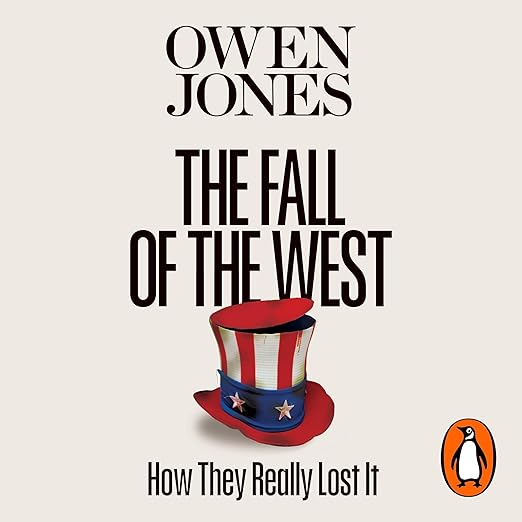
Owen Jones has an unusual talent among political commentators: he is angry in a way that is also analytical. The Establishment, his 2014 book on the interlocking power structures of British political and economic life, was one of the sharper pieces of political writing to emerge from the post-crash period, and it found a very large audience because it gave a name and a shape to something that many people could feel but struggled to articulate. The Fall of the West, announced by Penguin for October 2026, appears to be operating on a larger canvas – an attempt to explain how the Western liberal order went from the triumphalist certainty of the early 1990s to the existential fragility of the mid-2020s.
The argument that the West’s current crisis is self-inflicted rather than externally imposed – a consequence of its own hubris rather than the machinations of migrants, progressives, or whoever the current rhetorical target happens to be – is one that urgently needs making in the current political climate, and Jones is well-placed to make it.
About the Audiobook
The book’s central claim is that the collapse of the Soviet Union produced a dangerous triumphalism in Western political elites – a conviction that Western capitalism and liberal democracy had definitively won history, and that the task going forward was simply to extend this settlement globally. Jones traces how this hubris expressed itself through a series of catastrophic decisions: the invasions of Afghanistan and Iraq, the deregulatory excess that produced the 2008 financial crisis, and what he characterises as the moral authority squandered through Gaza. The thread connecting these episodes is elite self-interest dressed as universal values.
The second part of the argument – that the scapegoating of vulnerable groups is not an organic response to legitimate grievances but a deliberate narrative constructed to displace responsibility from the actual architects of decline – is familiar terrain for Jones but no less important for that. The rise of nationalist politics across the Western democracies is framed here not as a cause but as a symptom: of an elite failure of governance that created genuine suffering and then channelled the resulting anger towards those least able to defend themselves.
No narrator has been announced for the Audible edition at the time of writing, and the runtime is listed as not yet confirmed. This is very much a pre-release listing, but the content and authorial reputation make it one of the more anticipated political audiobooks of 2026.
The Narration
No narrator has been announced for the Audible UK edition at the time of writing. Given that this is an Owen Jones title from Penguin – a major publisher with a strong track record in political audiobooks – the casting will likely be professional and well-matched to the material. Updates to this listing will follow once the narrator is confirmed.
What Readers Say
As a pre-release title with an October 2026 publication date, there are no listener reviews to draw on. Jones’s previous work, however, gives a clear indication of the reception range to expect: his books tend to generate strong responses from both those who find his analysis clarifying and those who find his political framing reductive. The Establishment sold extremely well and was widely praised; it was also criticised from the right for treating capitalism’s failures as structural rather than correctable. Listeners should arrive with their own position in mind and treat this as the work of a committed and intelligent partisan rather than a neutral analysis.
Who Should Listen?
Listeners already engaged with questions of Western political economy and the causes of democratic backsliding will find this a compelling listen, whatever their starting position. Jones is worth reading even in disagreement – his arguments are serious and his evidence is substantial. Those looking for a more centrist or structurally sceptical treatment of Western decline might find Roger Eatwell and Matthew Goodwin’s National Populism a useful companion. This is, to be clear, a book with a clear political argument, and it makes no pretence otherwise. Listen on Audible UK