Clara’s Verdict
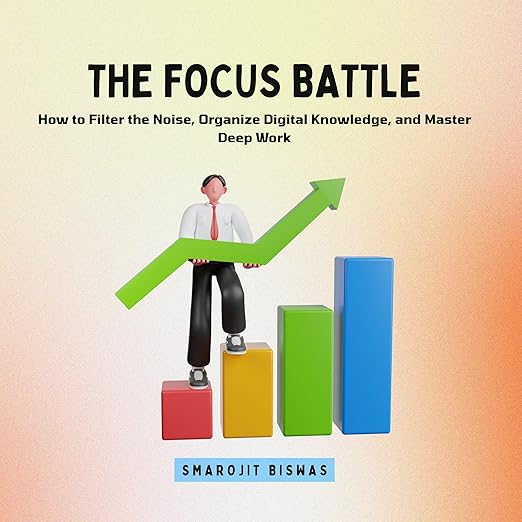
I started The Focus Battle on a morning when I had seventeen browser tabs open and had spent twenty minutes looking for my own coffee. SMAROJIT BISWAS’s core argument, that distraction is an environmental problem engineered by systems that monetise attention rather than a personal failing rooted in weak willpower, is one I find genuinely persuasive. The fact that a seventy-one-minute listen prompted me to close most of those tabs before it ended is, perhaps, the most honest endorsement I can offer.
Short-form personal development audiobooks live and die by the sharpness of their central insight and the quality of the framework they build around it. The Focus Battle has both. Biswas does not simply restate the well-worn case against smartphones. He goes further, examining the architecture of what he calls information decay and the cognitive cost of what he terms constant partial focus. These are useful concepts, articulated with more precision than the genre typically manages.
About the Audiobook
At just over an hour, the book covers a lot of conceptual ground efficiently. Biswas opens by framing attention fragmentation as a structural condition of contemporary life rather than a character defect, which immediately distinguishes this from the more self-flagellating entries in the productivity genre. He then walks through the psychology of cognitive overload, explaining how the brain processes competing information streams and why sustained deep thinking becomes increasingly difficult under conditions of permanent digital stimulation.
The second half introduces what Biswas calls mental architecture: a set of practical frameworks for restoring cognitive clarity through intentional filtering, personal knowledge management systems, and disciplined digital boundaries. The approach is systematic without being prescriptive. Biswas acknowledges that different listeners will need different implementations, and he resists the urge to present a one-size solution, which is considerably more honest than most books in this space allow themselves to be.
The section on personal knowledge systems is the most practically useful, offering a clear method for capturing and processing information without being overwhelmed by the sheer volume of it. The book also addresses the difference between what Biswas calls shallow information and deep thinking, and makes a convincing case for why the habit of moving quickly between many inputs actively degrades the capacity for the slower, more generative kind of thought.
Published in March 2026, the book feels very current in its awareness of how algorithmically curated content has accelerated the information overload problem. At seventy-one minutes, it makes an efficient argument for a topic that less disciplined writers tend to over-explain.
The Narration
Jake Andrews delivers a clean, focused performance, and there is a fitting symmetry in a narrator bringing calm attentiveness to a book about the difficulty of attentiveness. His tone is measured without being monotone, and he handles the more philosophical sections with the same steady clarity he brings to the practical ones. The listen never drags, and Andrews keeps the pace active enough that listeners who are prone to mind-wandering during audio will find him easy to stay with.
What Readers Say
As a very recently published, self-released title from March 2026, The Focus Battle has not yet gathered listener reviews on Audible. The absence of ratings should not be read as a comment on quality. This is simply a book still finding its audience in a crowded space.
Who Should Listen?
For anyone who suspects that the difficulty they have concentrating is less about personal discipline and more about the conditions in which they are trying to think, this is a worthwhile hour. It is particularly well-suited to knowledge workers, writers, and students who have noticed their capacity for sustained reading or thinking diminishing in recent years. The framework Biswas offers is actionable and does not require a complete digital detox to implement. Those who have already read Cal Newport’s Deep Work or Johann Hari’s Stolen Focus will find this a shorter, more concentrated companion to either, rather than a replacement for them.