Clara’s Verdict
I am not the target listener for The Frame Rate Frontier. I have not built a PC, I have no plans to build a PC, and the internal workings of a motherboard are a landscape I have always passed through with polite urgency when passing through has been unavoidable. But I found myself listening to this one-hour guide on a quiet Saturday morning out of genuine curiosity about whether a technical subject can be made genuinely accessible in audio format in sixty minutes without either condescending to the listener or failing to communicate anything of practical use. The answer is yes, with clearly stated caveats about scope that the book itself is honest about. Julian Carter’s guide is plainly written, honestly bounded, and designed for a specific audience that genuinely needs it. That is not nothing in a market saturated with technical content that either assumes too much prior knowledge or explains too little to be actionable.
From Unopened Boxes to Running Machine
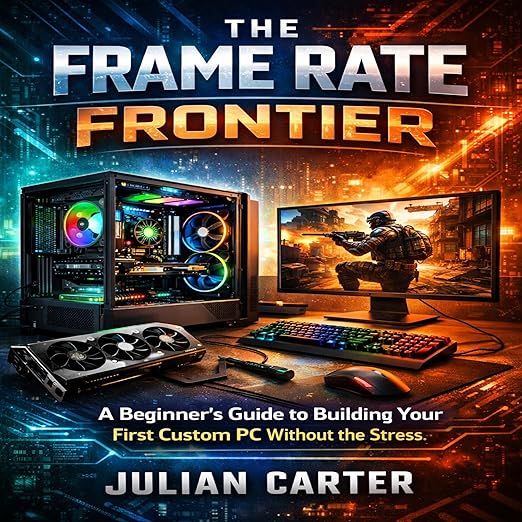
Published in March 2026 and running one hour exactly, The Frame Rate Frontier describes itself as a calm, step-by-step roadmap from unopened boxes to a fully powered machine. The book covers the selection of compatible components, the vocabulary of PC hardware including CPUs, GPUs, RAM, SSDs, and power supplies, safe workspace preparation to avoid electrostatic discharge damage, the installation sequence for core components outside the case before final assembly, cable management, BIOS configuration and enabling XMP or EXPO for full memory speed, Windows installation via bootable USB, driver installation, and the identification and resolution of common beginner errors. It also addresses future upgrades: swapping a GPU, adding storage, increasing memory without replacing the full machine, which is a genuinely useful section for listeners thinking not just about the first build but about its longevity as an investment.
That is a substantial list of topics for a sixty-minute listen, and the honest assessment is that Carter covers each at orientation level rather than with the depth that would allow a listener to sit down and build without additional research. A listener who has never encountered these concepts before will leave with a useful conceptual map and a vocabulary that will make further research, whether through video tutorials, dedicated building communities, or hardware forums, significantly more productive. A listener who needs granular technical guidance, specific component compatibility verification, detailed BIOS troubleshooting trees, or Windows activation edge cases, will need to supplement this audio with more targeted resources. The guide is transparent about this positioning and does not overstate what a single hour can deliver.
The title carries a mild gaming orientation: frame rates refer specifically to gaming performance metrics rather than general computing, and the framing assumes throughout that the primary use case for the build is gaming. The practical content applies equally to general-purpose and creative workstation builds, but listeners building for non-gaming purposes should know that the conceptual framing is gaming-oriented throughout, which may or may not affect how the advice lands for their specific situation.
Building Confidence Before Building Hardware
Devin Miller narrates, with a calm and methodical delivery that suits the instructional content well. For a technical subject aimed at people who describe themselves as overwhelmed and intimidated by a pile of components, the temptation in narration is either to rush through lists with false efficiency or to over-explain in ways that become patronising. Miller finds a reasonable middle ground. The pacing is deliberate without being slow, and the tone is reassuring rather than academic or technical, which is exactly the right register for a guide aimed at people who need confidence as much as they need information. The production is clean and straightforward throughout.
What Readers Say
No listener reviews or ratings are available at the time of writing, consistent with the March 2026 release date. The rating field in the product listing returned a shopping-cart error during data collection rather than a valid numerical score, which is a technical anomaly in the data rather than a reflection of the audiobook’s quality or reception. As with other short technical guides in this format, listener responses will likely centre on whether the one-hour runtime felt like a fair exchange for the information density delivered, and whether listeners who followed the framework were able to complete their builds with confidence and without significant additional troubleshooting. Those are questions that only time and accumulated listener experience can answer, but the clarity of the approach suggests the guide will serve its intended audience well. Comparable short PC-building introductions in the market have found consistent readership among people who want to know whether the process is within their capabilities before committing to the research required to actually execute it.
Who Should Listen?
This is for complete beginners to PC building who want to understand the overall shape of the process before committing to more detailed and specific resources. It works well as a first listen before consulting r/buildapc, watching full-length build guide videos, or reading dedicated hardware forums. It is not a standalone instruction manual and should not be treated as one. If you have already built a PC or watched more than two or three detailed build videos online, you will not find significant new material here. If you are genuinely starting from zero and want sixty minutes of structured, patient, jargon-controlled introduction to what is actually involved, The Frame Rate Frontier is exactly what it describes itself as: a roadmap for the beginning of a process, not a manual for completing it independently.