
Clara’s Verdict
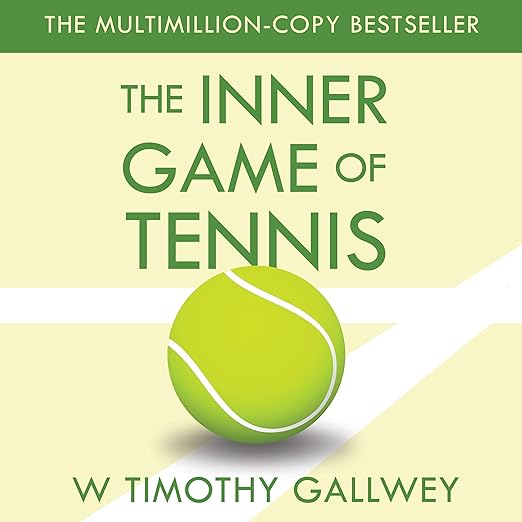
I have a rule about books that remain in print for fifty years: they deserve to be taken seriously. The Inner Game of Tennis was first published in 1974 and has never gone out of print. The 50th anniversary edition now comes with a foreword by Bill Gates, who describes it as one of the books he still gives to friends. Daniel Pink calls it “one of the most powerful mindset books ever written.” Billie Jean King called it her tennis bible. And the book itself – at four hours and thirty-six minutes in audio – has absolutely no interest in any of this celebrity endorsement. It is too busy being quietly correct about something most of us would rather not examine.
Timothy Gallwey’s central insight is deceptively simple: every game has an outer game and an inner game. The outer game is the one you can see – technique, tactics, opponents. The inner game is the one happening in your own mind, and it is often lost before a ball has been struck. Most coaching addresses only the outer game. Almost all performance problems are in the inner game.
This is one of those rare books that changes how you perceive your own thinking – not through abstract philosophy but through direct observation of what happens when you try to do something you already know how to do and something inside you gets in the way.
About the Audiobook
The Inner Game of Tennis is part of the Inner Game series, a body of work that grew from Gallwey’s experience as a tennis coach in California in the early 1970s. He began noticing that his most effective interventions weren’t technical corrections – they were shifts in how students were thinking about what they were doing. The more he told students what to do, the worse they often performed. The less he instructed and the more he invited them to simply observe and feel, the faster they improved.
Gallwey formalises this into a distinction between Self 1 – the critical, analytical, instructing voice in our heads – and Self 2 – the body’s natural intelligence, which already knows how to perform the action if Self 1 would get out of the way. The book is essentially a manual for quieting Self 1 and trusting Self 2, using tennis as the laboratory but making clear throughout that the same principles apply to music, work, relationships, and simply trying to function under pressure.
The framework draws on Zen thinking and humanistic psychology, but Gallwey is careful not to let it become mystical. The techniques he offers – focused awareness on the ball’s seams, mental imagery, non-judgmental observation of your own performance – are practical and immediately testable. This is a book about a specific, reproducible shift in attention, and it earns its longevity by being right.
The Narration
Dan Woren narrates this 50th anniversary edition, and he’s well suited to the material. His voice is calm and measured – appropriately so for a book about quieting the internal critic – and he handles the tennis-specific technical passages without making them feel like a manual. The prose itself is unadorned and direct, which makes the narrator’s job easier: there’s no need for dramatic inflection when the ideas are doing the work. At under five hours, this is one of those audiobooks that feels exactly the right length – long enough to develop its argument fully, short enough to revisit.
What Readers Say
Reviewers on Audible UK have been thoughtful and personal in their responses, which is a telling sign. “I’m a reasonable darts player who has suffered from nerves and self-doubt for years,” wrote one UK listener. “I’ve tried lots of other motivational books and videos but never found too much improvement until this book. The techniques make perfect sense and work with immediate results.” Another UK reviewer made the connection to Kahneman’s Systems 1 and 2, noting that Gallwey anticipated much of the cognitive science that followed. A third simply wrote: “There are a couple of concepts in this book that have transformed my relationship to the sport but that can also be more widely applicable to life.” The rating stands at 4.5 from nine reviewers for this edition, with five stars the most common score.
Who Should Listen?
Anyone who has ever noticed that they perform better when they think less about what they’re doing should listen to this. That includes athletes of any level, musicians, actors, public speakers, and people who find that they can do something well until someone is watching. The tennis framing is accessible even if you’ve never picked up a racquet – Gallwey is explicit about the universal applicability of his ideas, and the examples translate without difficulty.
It pairs well with Matthew Syed’s Bounce and with Cal Newport’s writing on deep work for listeners interested in the science of performance and attention. Available on Audible UK, Kobo, Scribd, and Storytel. Listen to The Inner Game of Tennis on Audible UK – fifty years in print, and every word still earns its place.